
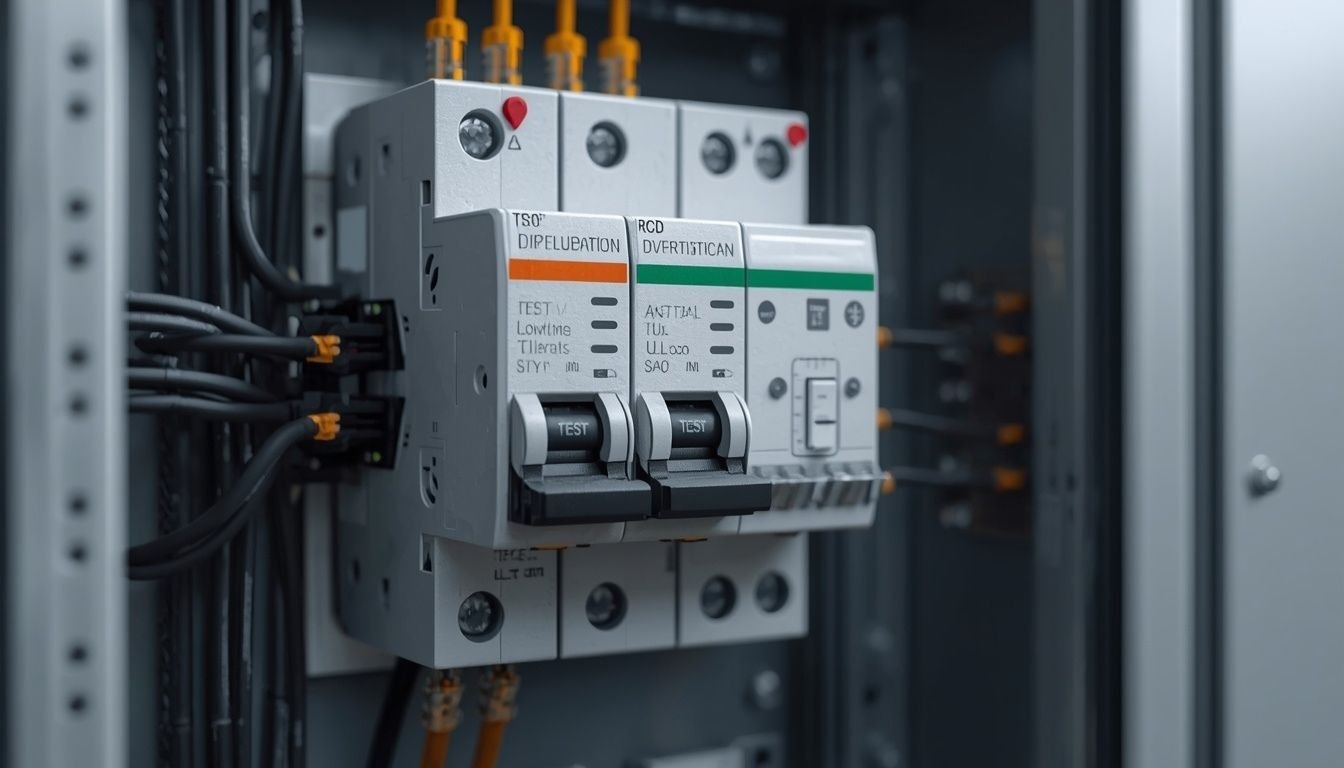
Electrical protection devices play an important role in preventing electric shock and reducing electrical hazards. Understanding electrical safety standards RCD differential circuit breaker wiring is particularly important when comparing international electrical systems with US installations.
A residual current device detects differences between the current flowing through circuit conductors. When some current escapes through an unintended path, the device disconnects the supply. This helps protect people from dangerous electrical faults.
In the United States, ground-fault circuit interrupters are the common equivalent technology for many residential and commercial applications. They are generally called GFCIs rather than RCDs.
However, these devices are not automatically interchangeable. Their ratings, product standards, installation requirements and approved applications differ.
Understanding these differences helps homeowners, contractors and electrical professionals select suitable protection and avoid unsafe wiring arrangements.
Key Takeaways
- RCDs detect electrical current leakage and disconnect power to reduce electric shock risks.
- The US primarily uses GFCI protection rather than the IEC-style RCD terminology.
- GFCI circuit breakers monitor current imbalance between ungrounded and grounded conductors.
- Correct line and load connections are essential for reliable ground-fault protection.
- Breaker selection and installation must follow the applicable NEC edition and local electrical requirements.
What Is an RCD or Differential Circuit Breaker?
An RCD is a protective electrical device that monitors the balance of current flowing through a circuit.
Under normal operating conditions, the current entering a circuit should match the current returning through its intended conductors.
If the two values become different, some electricity may be escaping through an unintended path. This can happen because of damaged insulation, faulty equipment or contact with a conductive surface.
The RCD detects this difference and disconnects the circuit when the leakage reaches its operating threshold.
How Differential Current Detection Works
An RCD uses a sensing component that monitors the conductors passing through it.
Its basic operating principle is:
- Electrical current travels through the outgoing conductor.
- Current returns through the corresponding return conductor.
- A sensing mechanism compares the magnetic effects of both currents.
- A difference indicates that current is escaping through another path.
- The device activates its tripping mechanism and disconnects the protected supply.
For example, consider a circuit carrying 10 amperes to an appliance and returning 10 amperes through its neutral conductor. The current is balanced.
If 10 amperes leave but only 9.995 amperes return, approximately 5 milliamperes are escaping through another path.
A standard Class A GFCI in the United States is designed to trip within its specified ground-fault operating range.
OSHA describes typical personnel-protection GFCI operation at approximately 5 milliamperes and interruption within as little as 1/40 of a second. Occupational Safety and Health Administration+1
What Does a Differential Circuit Breaker Protect Against?
A differential protection device can help protect against:
- Electric shock caused by current leakage.
- Insulation failures in electrical equipment.
- Ground faults involving conductive surfaces.
- Certain electrical fire hazards caused by leakage current.
However, an RCD does not replace every other protective device.
It does not necessarily protect against overloads or short circuits. Those conditions require suitable overcurrent protection.
It also cannot prevent every type of electric shock. For example, contact between two live conductors may not create a detectable current imbalance.
RCD vs GFCI vs RCCB vs RCBO
These terms describe related technologies, but they do not all mean the same thing.
The distinction matters when purchasing electrical protection equipment or comparing international wiring standards.
| Device | Main function | Overcurrent protection |
|---|---|---|
| RCD | Detects residual current | Depends on device type |
| RCCB | Detects residual current | No integral protection |
| RCBO | Detects residual current and circuit overcurrent | Yes |
| GFCI | Detects ground-fault current | Depends on product type |
| Standard circuit breaker | Protects against overloads and short circuits | Yes |
RCCB and RCBO Differences
An RCCB provides residual-current protection but does not normally include overload or short-circuit protection.
It must be coordinated with an appropriately rated circuit breaker.
An RCBO combines residual-current protection and overcurrent protection in one device.
This can simplify individual circuit protection because both functions are integrated into one protective unit.
Why the US Uses GFCI Instead of RCD Terminology
The United States follows a different electrical product and code framework from countries using IEC-based installations.
The National Electrical Code uses GFCI terminology for ground-fault protection of personnel.
In practical terms:
- GFCI receptacles protect their own outlet and potentially downstream outlets.
- GFCI circuit breakers protect the branch circuit connected through the breaker.
- Combination breakers can provide both ground-fault and arc-fault protection when designed and listed for that purpose.
An IEC-rated RCCB or RCBO should not automatically be considered an approved replacement for a US-listed GFCI breaker.
Product certification, electrical ratings, panel compatibility and local code acceptance must all be checked.
Electrical Safety Standards and Regulations in the United States
Electrical installations in the United States must follow applicable electrical codes and product safety requirements.
The National Electrical Code is the primary model code used for many building electrical installations. However, it is not automatically adopted in the same form everywhere.
States and local jurisdictions determine which edition applies and whether local amendments are required.
National Electrical Code Requirements
NFPA 70, known as the NEC, contains requirements for ground-fault protection in different residential, commercial and industrial applications.
Several important provisions include:
| NEC provision | General subject |
|---|---|
| Article 100 | Electrical definitions |
| 110.3(B) | Installation and use according to equipment listing and labeling |
| 210.8 | GFCI protection requirements |
| 210.12 | Arc-fault circuit interrupter requirements |
| 250 | Grounding and bonding |
| 240 | Overcurrent protection |
| 680 | Swimming pools, spas and similar installations |
The exact requirements depend on the applicable NEC edition, installation type and local amendments.
Where GFCI Protection Is Required
GFCI protection is required in many locations where electrical equipment may encounter moisture or other ground-fault hazards.
Common residential applications include:
- Bathrooms.
- Kitchens.
- Garages.
- Outdoor receptacles.
- Basements.
- Crawl spaces.
- Laundry areas.
- Certain locations near sinks.
- Indoor wet and damp locations.
The NEC also contains requirements for particular appliances and equipment. Some applications involve hardwired equipment rather than ordinary receptacles.
The exact requirements depend on voltage, circuit configuration, location and applicable exceptions.
For example, the 2023 and 2026 NEC editions address GFCI protection for certain outdoor HVAC equipment under Article 210.8(F). Equipment compatibility and applicable exceptions must be considered. UL Solutions+1
UL 943 and GFCI Product Safety
UL 943 is an important product safety standard for ground-fault circuit interrupters.
It addresses the construction and performance requirements of covered GFCI products.
Class A GFCIs are commonly used for personnel protection in residential applications.
Their ground-fault operating range is approximately 4 to 6 milliamperes.
When selecting equipment, check for:
- Appropriate UL certification or other accepted product certification.
- Correct voltage and current ratings.
- Suitable installation environment.
- Compatibility with the electrical panel.
- Manufacturer installation instructions.
A product that physically fits an electrical panel is not necessarily approved for use in that panel.
RCD and Differential Circuit Breaker Wiring Principles
Electrical safety standards RCD differential circuit breaker wiring requirements focus on correct conductor routing, device ratings, grounding arrangements and product compatibility.
Although international RCD installations and US GFCI installations share the principle of detecting current imbalance, their wiring arrangements and approved products can differ.
Line and Load Connections
Protective devices commonly have designated supply-side and load-side terminals.
These connections have different purposes.
Line terminals
The line side receives electrical power from the supply.
Load terminals
The load side supplies the protected circuit or downstream equipment.
Neutral connection
Where a device monitors neutral current, the neutral conductor must follow the manufacturer’s specified connection arrangement.
Some GFCI breakers also have a separate neutral pigtail that connects to the panel neutral bar.
Other designs use different terminal arrangements.
The actual configuration depends on the specific breaker model.
Why Neutral Connections Matter
A common problem with differential protection is an incorrect neutral connection.
The sensing mechanism must monitor the intended outgoing and returning current paths.
Incorrect neutral arrangements can cause:
- Immediate nuisance tripping.
- Failure to reset.
- Loss of downstream power.
- Incorrect operation of protective equipment.
A shared neutral or multiwire branch circuit also requires appropriate protection and coordination.
Simply connecting conductors to terminals based on their colors is not sufficient.
Grounding and Bonding Requirements
The equipment grounding conductor provides a low-impedance path for fault current under appropriate fault conditions.
It is an important part of electrical safety and must be installed according to the applicable code.
The neutral and equipment grounding conductor have different functions.
They must not be casually connected together downstream of the service bonding point.
An improper neutral-to-ground connection can create parallel current paths and interfere with protective operation.
Important Wiring Safety Considerations
The following principles apply when evaluating an installation:
- Use a breaker approved for the specific panel.
- Follow the manufacturer’s terminal and conductor instructions.
- Confirm the correct voltage and current ratings.
- Verify neutral and grounding arrangements.
- Check conductor size and circuit ampacity.
- Confirm that the protective device is suitable for the intended application.
- Have the completed installation inspected and tested as required.
Safety warning: Electrical panel wiring can expose a person to lethal voltage. The information above explains device operation and wiring principles rather than providing a live installation procedure. Breaker installation and modifications should be performed by a qualified electrician with appropriate isolation and verification procedures.
Different Types of RCDs and Their Applications
Not every residual current device detects the same types of electrical faults.
The correct selection depends on the electrical load, possible leakage-current waveform and manufacturer’s specifications.
| RCD type | Detection capability | Typical application |
|---|---|---|
| Type AC | Sinusoidal AC residual current | Basic AC loads where permitted |
| Type A | AC and pulsating DC residual current | Many modern household appliances |
| Type F | Type A capabilities with additional frequency-related detection | Certain inverter-controlled appliances |
| Type B | AC, pulsating DC and smooth DC residual current | Certain EV charging and industrial applications |
These classifications are associated with IEC-based protection systems. They should not be confused with US GFCI product classifications.
Type AC RCD
Type AC devices detect sinusoidal alternating residual current.
Their applications are more limited where electronic equipment can produce other forms of leakage current.
Type A RCD
Type A devices can detect sinusoidal AC and pulsating DC residual currents.
They are commonly considered for installations containing electronic equipment and modern household appliances.
Type F RCD
Type F devices provide additional detection capabilities for certain mixed-frequency residual currents.
They may be appropriate for selected appliances using variable-speed drives or inverter technology.
Type B RCD
Type B devices provide broader residual-current detection, including smooth DC residual currents.
They are used in applications where equipment can generate these types of leakage current.
Examples include certain electric vehicle charging installations, photovoltaic systems and industrial equipment.
The equipment manufacturer’s instructions and applicable electrical standards determine the correct protection type.
Choosing Between an RCD, RCBO and GFCI Circuit Breaker
Selecting an electrical protection device requires more than comparing its price or sensitivity rating.
The most suitable option depends on the installation, the type of electrical load and the protection required.
When an RCCB Makes Sense
An RCCB may be suitable for an IEC-based distribution system where residual-current protection is provided separately from overcurrent protection.
It can protect multiple circuits when the installation design and applicable regulations permit it.
However, a shared RCCB may disconnect several circuits when one circuit develops a fault.
This can affect electrical availability.
When an RCBO Makes Sense
An RCBO is useful when individual circuits need combined residual-current and overcurrent protection.
For example, separate RCBOs may be used for:
- Kitchen circuits.
- Bathroom circuits.
- Outdoor equipment.
- Laundry circuits.
- Individual appliance circuits.
Individual protection can reduce the number of unaffected circuits disconnected by a single fault.
When a GFCI Circuit Breaker Makes Sense
For US installations, a listed GFCI circuit breaker is an option when branch-circuit ground-fault protection is required.
It can provide protection to the entire connected branch circuit when correctly selected and installed.
A GFCI receptacle may be another option depending on the circuit arrangement and applicable code.
Comparison of Protection Options
| Selection factor | RCCB | RCBO | GFCI breaker |
|---|---|---|---|
| IEC-based installation | Yes | Yes | Not normally |
| US installation | Not automatically approved | Not automatically approved | Yes, when properly listed and suitable |
| Residual-current protection | Yes | Yes | Yes |
| Overcurrent protection | No | Yes | Depends on breaker design |
| Individual circuit protection | Possible with suitable arrangement | Yes | Yes |
| Separate overcurrent breaker required | Yes | No | No for an integrated listed breaker |
The important distinction is that an RCCB, RCBO and GFCI breaker belong to different product and installation frameworks. Selection should begin with the jurisdiction and applicable code rather than the device name.
Common Wiring and Protection Problems That Cause RCD Tripping
Unexpected tripping does not always mean that a protective device is defective.
It may indicate an actual electrical fault or an installation problem.
Understanding the possible causes helps electricians diagnose the problem without replacing equipment unnecessarily.
Neutral-to-Ground Connections
An unintended connection between neutral and ground downstream of the appropriate bonding point can create an unwanted current path.
A differential protection device may detect this as an imbalance and disconnect the circuit.
Shared Neutral Problems
Some branch circuits share a neutral conductor.
If the protective device does not monitor the correct conductors together, it may detect an imbalance even when the connected equipment is operating normally.
These arrangements require proper circuit design and compatible protection.
Damaged Insulation
Insulation deterioration can allow current to escape from an energized conductor.
Possible causes include:
- Aging electrical cables.
- Moisture exposure.
- Physical cable damage.
- Overheated insulation.
- Damaged appliance wiring.
The correct response is to locate and correct the underlying fault rather than repeatedly resetting the breaker.
Excessive Leakage Current
Some electronic appliances produce small amounts of normal leakage current.
When several devices share one protective device, their combined leakage can contribute to unwanted tripping.
Proper circuit separation and suitable protective-device selection can help address this issue.
Incorrect Device Selection
A breaker with unsuitable electrical characteristics may not provide the required protection.
Examples include incorrect voltage ratings, unsuitable residual-current sensitivity or incompatible equipment.
The solution is to verify the complete installation design and product specifications.
How to Test and Maintain Differential Protection Devices
Testing is an important part of electrical safety because protective devices can develop faults or stop operating correctly.
Most modern GFCI breakers and receptacles include a test function.
Testing a GFCI Breaker
A typical test involves the following checks:
- Identify the protective device and review its manufacturer’s testing instructions.
- Confirm that the connected equipment can safely lose power.
- Use the device’s TEST function as instructed.
- Verify that the breaker trips and disconnects the protected circuit.
- Reset the device according to its instructions.
- Arrange professional inspection if the test fails.
A failed test should not be ignored.
If the device does not trip or cannot reset correctly, it may require replacement or further investigation.
Recommended Testing Frequency
For residential GFCI protection, ESFI recommends monthly testing.
The exact procedure should follow the product manufacturer’s instructions.
| Maintenance activity | Recommended approach |
|---|---|
| GFCI functional test | Monthly guidance for residential devices |
| Visual inspection | Look for damage, corrosion and overheating |
| Breaker operation | Investigate unexplained or repeated tripping |
| Wiring inspection | Have a qualified electrician assess suspected faults |
| Device replacement | Replace defective or damaged equipment with compatible listed products |
A test button checks the device’s internal operating function. It does not verify every aspect of the installation or prove that all grounding and wiring arrangements are correct.
RCD and GFCI Protection in Commercial and Industrial Installations
Commercial and industrial electrical systems often contain more complex loads than residential installations.
Motors, pumps, variable-frequency drives, electronic controls and power conversion equipment can produce different residual-current characteristics.
This makes protective-device selection particularly important.
Motor and Industrial Equipment
Industrial motors may produce leakage currents associated with insulation conditions, cable length and electronic motor controls.
The protection system should account for the equipment’s operating characteristics.
Using an unsuitable device may result in unwanted interruptions or inadequate fault detection.
Electric Vehicle Charging Equipment
EV charging equipment can introduce smooth DC residual-current components depending on its design.
Some charging installations require Type B protection or another manufacturer-approved arrangement that provides the required DC fault protection.
A standard household GFCI should not automatically be treated as equivalent to an IEC Type B RCD.
The charging equipment documentation and applicable US electrical requirements should determine the appropriate solution.
Solar and Inverter Systems
Solar inverters and other power conversion equipment can produce residual currents with different characteristics.
The protection arrangement must be compatible with the inverter design.
A qualified electrical professional should review the manufacturer’s specifications and the applicable installation requirements before selecting protection.
Construction Site Electrical Safety
Construction environments have additional electrical risks because tools, extension cords and temporary wiring are exposed to frequent movement and physical damage.
OSHA requires appropriate ground-fault protection for covered construction-site receptacles.
Under OSHA 29 CFR 1926.404(b)(1), employers must use GFCIs or an approved assured equipment grounding conductor program for the specified applications.
For example, the regulation addresses 120-volt single-phase 15- and 20-ampere receptacle outlets that are not part of permanent building wiring and are used by employees.
This is an important distinction between general residential code requirements and workplace safety obligations. Occupational Safety and Health Administration+1
Expert Guide to Selecting the Correct Differential Protection Device
Before purchasing or specifying a protective device, evaluate the electrical installation as a complete system.
The following decision framework helps identify the most suitable option.
1. Identify the Electrical Code Framework
First establish whether the installation follows US NEC requirements or an IEC-based electrical standard.
- For US installations, investigate appropriately listed GFCI products.
- For IEC-based installations, evaluate RCCB and RCBO options.
- Check local electrical regulations and inspection requirements.
This prevents selecting a device that may be technically similar but unsuitable for the installation.
2. Determine the Required Protection
Identify which electrical hazards need protection.
| Protection requirement | Suitable device consideration |
|---|---|
| Ground-fault protection | GFCI or suitable RCD |
| Overload protection | Circuit breaker or integrated RCBO |
| Short-circuit protection | Appropriately rated circuit breaker |
| Combined residual and overcurrent protection | RCBO or suitable GFCI breaker |
| Arc-fault protection | AFCI or compatible combination device |
Remember that ground-fault, arc-fault and overcurrent protection perform different functions.
3. Check Electrical Ratings
Review these specifications before selecting equipment:
- Rated operating voltage.
- Rated current.
- Number of poles.
- Residual-current operating characteristics.
- Short-circuit interrupting rating.
- Frequency compatibility.
- Panel and manufacturer compatibility.
A device should not be selected based on its current rating alone.
4. Evaluate the Connected Equipment
Different electrical loads can produce different leakage-current characteristics.
A basic household circuit may have different requirements from an EV charger, industrial motor or inverter-based system.
Check the equipment manufacturer’s recommendations before deciding which protection technology is appropriate.
5. Consider Maintenance and Circuit Availability
Think about what happens when a fault occurs.
A shared residual-current protection device may disconnect several circuits at once.
Individual RCBOs or suitable branch-circuit protection can help isolate faults and maintain power to unaffected equipment.
For installations where uninterrupted operation matters, this can be an important design consideration.
Practical recommendation: For a US residential installation, start with the applicable NEC requirements and a compatible listed GFCI breaker or receptacle. For an IEC-based installation, evaluate whether an RCCB with separate overcurrent protection or an individual RCBO better suits the circuit design.
Do not select an IEC RCD simply because its specifications appear similar to those of a US GFCI product.
Frequently Asked Questions
1. What is the difference between an RCD and a differential circuit breaker?
An RCD detects differences between outgoing and returning electrical current.
A differential circuit breaker generally refers to a circuit protection device incorporating residual-current detection. Depending on its design, it may also provide overload and short-circuit protection.
2. Are RCDs and GFCIs the same?
They use a similar current-imbalance detection principle.
However, their product standards, ratings and installation requirements differ. RCD is common IEC terminology, while GFCI is the standard US term for ground-fault protection of personnel.
3. What electrical standards apply to RCD differential circuit breaker wiring?
In the United States, relevant requirements include NFPA 70 and UL 943 for covered GFCI products.
IEC-based installations commonly use IEC 61008 for RCCBs and IEC 61009 for RCBOs.
The applicable jurisdiction determines which standards and installation requirements must be followed.
4. Does an RCD protect against overloads and short circuits?
Not every RCD provides this protection.
An RCCB generally requires separate overcurrent protection. An RCBO combines residual-current and overcurrent protection in one device.
A GFCI circuit breaker also provides overcurrent protection through its breaker function.
5. What causes a differential circuit breaker to trip?
Common causes include:
- Current leakage.
- Damaged cable insulation.
- Faulty appliances.
- Moisture entering electrical equipment.
- Incorrect neutral connections.
- Shared neutral wiring problems.
- Accumulated leakage current from connected equipment.
Repeated tripping should be investigated rather than ignored.
6. Can an RCD work without an earth connection?
A residual-current device can detect an imbalance without relying on the equipment grounding conductor to sense the fault.
However, this does not make an ungrounded installation safe or eliminate applicable grounding requirements.
A properly designed grounding system remains an essential part of electrical protection.
7. How often should a GFCI circuit breaker be tested?
Monthly testing is recommended by the Electrical Safety Foundation International for residential GFCI devices.
Always follow the manufacturer’s instructions. A failed test requires professional assessment.
8. What is the difference between Type A and Type B RCDs?
Type A detects AC and pulsating DC residual currents.
Type B provides broader detection capabilities, including smooth DC residual currents.
Type B may be necessary for certain inverter-based applications and EV charging installations, depending on the equipment design.
9. Can an RCD replace a standard circuit breaker?
An RCCB cannot normally replace a standard circuit breaker because it does not provide integral overload and short-circuit protection.
An RCBO combines these protective functions and may be used where its ratings and installation requirements are suitable.
10. Why does a GFCI breaker trip immediately after installation?
Possible reasons include:
- Incorrect line or load connections.
- Improper neutral wiring.
- An unintended neutral-to-ground connection.
- A downstream wiring fault.
- An incompatible breaker.
- A defective protective device.
A qualified electrician should inspect the installation before further operation.
Choosing Protection That Matches the Electrical Installation
Electrical protection depends on using the correct device for the electrical system rather than choosing a breaker based only on its appearance or current rating.
For US installations, GFCI protection must meet applicable NEC requirements and use appropriately listed equipment. IEC-based installations require suitable RCD protection selected according to the installation design and relevant IEC standards.
The most important considerations are correct product selection, compatible wiring arrangements, proper grounding, suitable overcurrent protection and regular functional testing.
When these elements work together, the installation has a more reliable approach to reducing electrical shock and ground-fault hazards.