
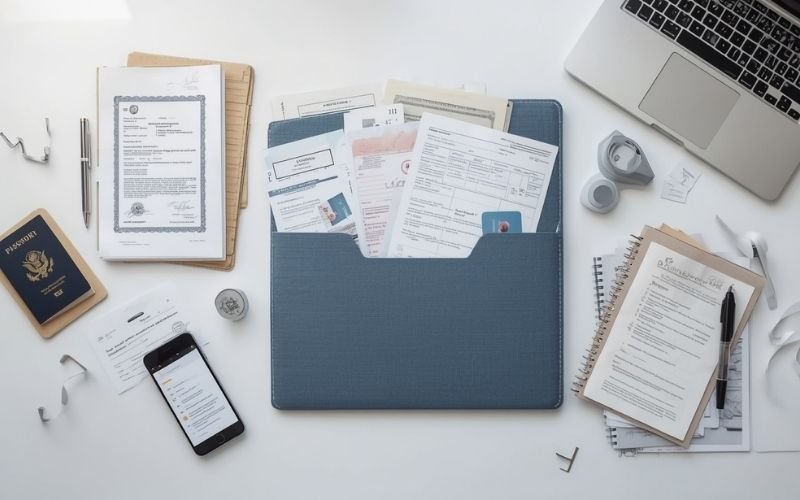
Important documents can become difficult to replace when a family is dealing with an urgent situation, a move, an immigration filing, or unexpected travel. Keeping key records organized and accessible can make it easier to confirm identity, review immigration facts history, or prepare documents when they are needed.
The exact documents each family needs will depend on their immigration status and individual circumstances.
1. Passports and Travel Documents
Each family member should keep their current passport or other applicable travel document in a secure location.
A copy of the passport biographical page can also be useful for records. The U.S. Department of State recommends keeping copies of important passport-related documents in certain travel situations.
Check expiration dates regularly, especially when international travel may be involved.
2. Immigration Documents
Keep copies of immigration documents issued by U.S. authorities.
Depending on a person’s situation, these may include:
- Permanent Resident Card (Form I-551)
- Employment Authorization Document (Form I-766)
- Form I-94
- Form I-797 notices
- Form I-20
- Form DS-2019
- Refugee Travel Document
- Re-entry Permit
- Other documents issued by USCIS or related agencies
USCIS identifies many of these as commonly used immigration documents.
Not every person will have every document on this list.
3. Form I-94
For people whose immigration history includes an I-94 record, keeping a copy or accessible record can be particularly useful.
USCIS instructions for certain applications specifically refer to the I-94 as evidence that may need to be provided.
Families should check their own records and keep the relevant version available.
4. Employment Authorization Documents
If a family member has an Employment Authorization Document (EAD), keep a copy of the card along with information about its validity period.
USCIS application guidance identifies Form I-766 as an employment authorization document and may require copies of previous EADs in certain applications.
Do not assume that an expired document provides current work authorization. Always check the applicable official information for the person’s situation.
5. Birth Certificates
Birth certificates can help establish identity, date of birth, and family relationships.
Keep copies for each family member, including children. If documents were issued outside the United States, families should also keep any required translations or supporting records that apply to their circumstances.
6. Marriage, Divorce, and Family Records
Documents showing family relationships can become important during certain immigration processes.
Depending on the family, this may include:
- Marriage certificates
- Divorce decrees
- Adoption records
- Custody documents
- Legal guardianship records
- Children’s birth certificates
Keep documents that accurately reflect the family’s current legal situation.
7. Immigration Application Records
Do not overlook paperwork connected to previous immigration applications.
Families may want to keep copies of:
- Submitted applications
- USCIS notices
- Approval notices
- Requests for Evidence
- Appointment notices
- Receipts
- Supporting evidence
- Correspondence related to an immigration case
Keeping these records together can make it easier to understand what has already been submitted and what notices have been received.
8. Court or Legal Documents
If a family member has received an immigration-related court document or other legal paperwork, keep the original and appropriate copies in a secure location.
Examples may include notices, orders, or other documents connected with an immigration proceeding.
Because legal circumstances vary significantly, families should not assume that one document applies in the same way to everyone.
9. Identity Documents
Keep current identity documents for each family member where applicable.
These might include:
- State-issued identification
- Driver’s license
- Foreign national ID
- Passport
- Other government-issued identification
USCIS guidance lists several forms of government-issued identity documentation that may be used in different immigration processes.
10. Proof of Address and Residence
Some immigration processes may require evidence showing where a person has lived or worked.
Depending on the situation, useful records can include:
- Lease agreements
- Utility records
- Employment records
- Pay statements
- Tax records
- School records
- Official correspondence
USCIS materials identify employment and other records as examples of evidence that can be used to establish residence in certain immigration processes.
11. Tax and Employment Records
Tax documents and employment records can become important when someone needs to document work or residence history.
Consider keeping copies of relevant:
- W-2 forms
- Tax returns
- Pay statements
- Employer records
- Employment letters
The exact records needed will depend on the purpose for which they are being requested.
12. Children’s School and Medical Records
Families with children should also consider keeping important school and medical records organized.
These may help document:
- Identity
- Date of birth
- School history
- Medical history
- Family relationships
Keep only the information that is genuinely needed and protect these records carefully because they contain sensitive personal information.
Keep Originals and Copies Separate
Important original documents should be stored somewhere secure rather than carried around unnecessarily.
Create clear copies of documents that may be needed for applications, identification, or records.
USCIS guidance also emphasizes following the specific filing instructions for each application and not sending original documents unless the instructions specifically request them.
Create a Secure Digital Backup
A secure digital copy can provide an additional backup if a paper document is lost or damaged.
A family can scan important documents and store them in a protected location with strong account security.
Avoid keeping sensitive documents in an unsecured public folder or sending them casually through messaging apps.
Keep a Simple Document Checklist
A basic family checklist can make document management easier.
For each person, record:
| Document | Original | Copy | Expiration/Update |
|---|---|---|---|
| Passport | ✓ | ✓ | Check regularly |
| Immigration documents | ✓ | ✓ | Check validity |
| Birth certificate | ✓ | ✓ | Keep current records |
| Employment authorization | ✓ | ✓ | Check expiration |
| Identity documents | ✓ | ✓ | Check validity |
| Family records | ✓ | ✓ | Update after changes |
| Immigration notices | ✓ | ✓ | Keep case records |
| Tax/employment records | ✓ | ✓ | Keep relevant years |
The checklist should be customized to the family’s actual circumstances.
Review the Folder Regularly
Documents should not simply be collected and forgotten.
Review the folder periodically and check for:
- Expired passports
- Expired identity documents
- Outdated immigration documents
- Missing copies
- New USCIS notices
- Changes in family relationships
- Updated addresses
- New application records
Regular reviews can prevent an important document from becoming difficult to find when it is needed.
Protect the Information
Immigration records contain highly sensitive personal information.
Use secure physical storage and strong digital security. Limit access to people who genuinely need it.
Do not upload passports, immigration documents, or other sensitive records to unknown websites simply because they offer document-storage or verification services.
Final Takeaway
Keeping essential documents organized gives immigrant families a practical way to manage important records when they need them.
Passports, immigration documents, identity records, family documents, application notices, employment records, and other relevant paperwork should be stored securely, backed up appropriately, and reviewed regularly.
The right document list depends on each family’s immigration status and circumstances, so official instructions should always take priority when a specific application or legal process requires particular evidence.
FAQs
What documents should immigrant families keep?
Common records include passports, immigration documents, identity documents, birth certificates, family records, USCIS notices, employment records, and other documents relevant to the family’s individual circumstances.
Should I keep copies of immigration documents?
Yes. Keeping secure copies can make it easier to access important information when an original document is unavailable.
Should original immigration documents be carried everywhere?
Not necessarily. Important originals should generally be stored securely unless they are specifically needed. Follow the instructions of the relevant agency or process.
Should immigration documents be stored digitally?
A secure digital backup can be useful, provided sensitive information is protected with appropriate security measures.
How often should families review their documents?
A periodic review is useful, particularly after receiving a new immigration notice, changing address, renewing a document, or experiencing a change in family circumstances.
Does every immigrant need the same documents?
No. Required documents vary according to immigration status, family circumstances, and the specific application or process involved.