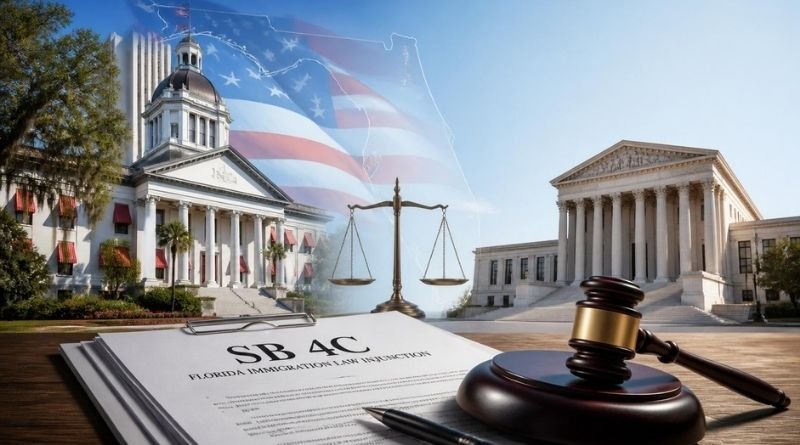
Florida’s Senate Bill 4C (SB 4C) became one of the most debated immigration laws in the United States after federal courts stopped it from taking effect. The legislation proposed new state-level criminal penalties related to unauthorized entry and expanded Florida’s role in immigration enforcement. Before the law could be fully implemented, several organizations challenged it in federal court, arguing that it conflicted with the U.S. Constitution and existing federal immigration law.
As a result, a federal judge issued an injunction that temporarily blocked enforcement while the lawsuit moves forward. Higher courts later allowed that injunction to remain in place, making the case an important legal dispute over the balance of power between state governments and the federal government.
This article explains what Florida’s immigration law proposed, why the injunction was issued, and what the ongoing legal proceedings could mean for residents, policymakers, and future immigration legislation.
Quick Overview
| Topic | Information |
|---|---|
| Law | Florida Senate Bill 4C (SB 4C) |
| State | Florida, United States |
| Issue | State immigration enforcement |
| Current Status | Enforcement temporarily blocked by federal court |
| Main Legal Question | Does SB 4C conflict with federal immigration law? |
What Is Florida Senate Bill 4C?
Senate Bill 4C is a Florida law passed during a special legislative session in 2025. The bill introduced new state criminal offenses related to unauthorized entry or re-entry into Florida and expanded the authority of state law enforcement in certain immigration-related situations.
Supporters argued that the legislation would strengthen public safety and support immigration enforcement within the state. Opponents maintained that immigration regulation is primarily a federal responsibility and that Florida had exceeded its constitutional authority.
These disagreements led to a federal lawsuit shortly after the bill was signed into law.
Why Did the Court Issue an Injunction?
An injunction is a court order that temporarily prevents a law from being enforced while judges decide whether it complies with the Constitution and federal law.
In the case of SB 4C, the federal court concluded that the plaintiffs had raised substantial legal questions that deserved a full review before the law could take effect. Rather than allowing enforcement during the litigation, the court ordered that implementation be paused until the case proceeds further.
It is important to understand that the injunction does not permanently invalidate the law. It simply maintains the current legal position while the courts examine the issues in detail.
Why Is This Case Legally Important?
The central issue is not whether immigration laws should exist, it is which level of government has the authority to enforce them.
Under the U.S. Constitution, immigration policy is largely managed by the federal government through laws such as the Immigration and Nationality Act (INA). While states may cooperate with federal agencies, they generally cannot establish immigration systems that conflict with federal law.
The lawsuit argues that parts of SB 4C created enforcement mechanisms that overlap with or interfere with existing federal authority. Florida, on the other hand, maintains that the legislation complements federal immigration enforcement rather than replacing it.
Resolving that disagreement is now the responsibility of the federal courts.
What Does the Injunction Mean Right Now?
While the injunction remains in effect:
- The challenged provisions of SB 4C cannot be enforced.
- State agencies must follow the federal court’s order.
- The legal challenge continues through the federal court system.
- No final ruling has yet determined whether the law is constitutional.
Until the courts issue a final decision, the future of SB 4C remains uncertain.
Timeline of the Case
2025 – Florida passes Senate Bill 4C.
The Governor signs the bill into law.
Civil rights organizations and affected individuals file a federal lawsuit.
A federal district court issues a preliminary injunction.
Florida appeals the decision.
The injunction remains in effect while the appeal continues.
What Could Happen Next?
The future of SB 4C depends on the outcome of the ongoing legal proceedings. Since the law is currently blocked by a federal injunction, it cannot be enforced unless the courts decide otherwise.
Several outcomes are possible:
- The courts could uphold the injunction and permanently block the challenged provisions.
- Some parts of the law could be modified while others remain valid.
- Florida could continue appealing the decisions through higher federal courts.
- Lawmakers could introduce revisions to address the constitutional concerns raised during the lawsuit.
Until a final judgment is issued, the legal status of SB 4C remains unresolved.
What Does This Mean for Florida Residents?
The injunction does not change current federal immigration laws. Instead, it temporarily prevents Florida from enforcing the challenged provisions of SB 4C.
For residents, this means the legal framework that existed before the law was blocked generally remains in place while the case continues.
Anyone with questions about their individual immigration status or legal rights should seek advice from a qualified immigration attorney or an accredited legal service provider.
Why Is This Case Being Watched Nationwide?
Although the lawsuit involves Florida, its impact could extend beyond one state.
Several states have introduced immigration-related legislation in recent years. Because federal courts often rely on previous legal decisions when reviewing similar cases, the outcome of this lawsuit may influence future debates about the role states can play in immigration enforcement.
For policymakers, legal professionals, and advocacy organizations, the case represents another important discussion about the balance between state authority and federal responsibility.
Understanding the Legal Debate
Supporters and opponents of SB 4C agree that immigration enforcement is an important issue, but they disagree on who should have the authority to regulate it.
Supporters believe the law could:
- Strengthen cooperation with immigration enforcement efforts.
- Give state officials additional enforcement tools.
- Improve public safety through stricter immigration measures.
Opponents argue the law could:
- Conflict with federal immigration authority.
- Lead to constitutional challenges.
- Create uncertainty for residents and local agencies.
These competing legal arguments are now being examined by the federal courts.
Frequently Asked Questions
What is the Florida immigration law injunction?
The Florida immigration law injunction is a federal court order that temporarily blocks enforcement of parts of Senate Bill 4C while the lawsuit challenging the law continues.
Is SB 4C currently in effect?
The challenged provisions remain blocked under the federal court’s injunction while the case moves through the judicial process.
Why was the law challenged?
Plaintiffs argued that parts of SB 4C conflict with federal immigration law and raise constitutional questions regarding the division of authority between state and federal governments
Has the case been decided?
No. The litigation is still ongoing, and the courts have not issued a final decision on the constitutionality of the law.
Could the law still take effect?
Yes. If the courts ultimately uphold all or part of the legislation, some provisions could become enforceable. If the courts rule against the law, the challenged sections may remain blocked or be struck down.
Why is this case important outside Florida?
The lawsuit addresses broader constitutional questions about how much authority individual states have over immigration enforcement. Future legislation in other states may be influenced by the courts’ interpretation of these issues.
Final Thoughts
The Florida immigration law injunction has become one of the most closely followed immigration cases in the United States because it examines the limits of state authority in an area traditionally governed by federal law.
While Florida argues that Senate Bill 4C supports immigration enforcement within the state, the plaintiffs maintain that the legislation conflicts with the federal immigration system established under U.S. law. The federal courts have temporarily paused enforcement while these legal questions are fully reviewed.
As the case continues, future court decisions will determine whether SB 4C can be enforced, modified, or permanently blocked. Until then, residents, legal professionals, and policymakers should rely on official court records and government updates for the most accurate information.