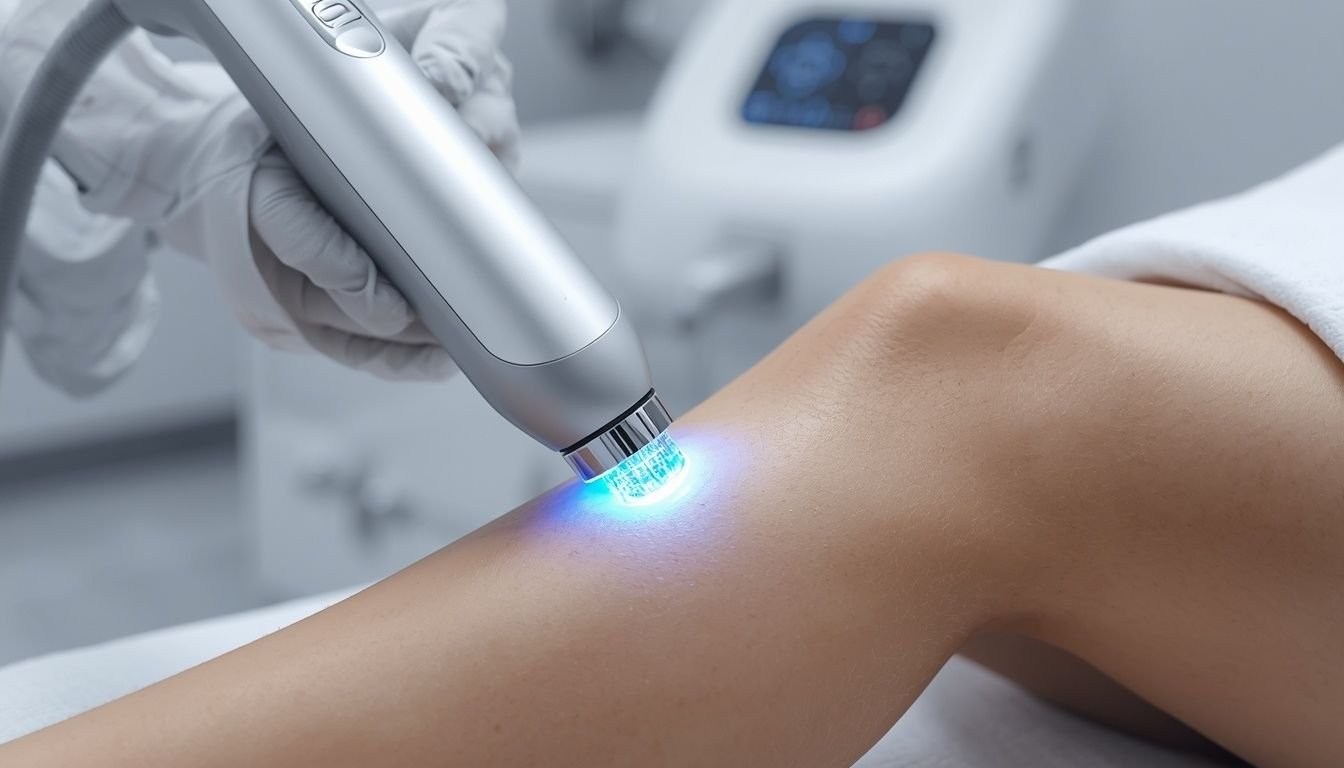
Soprano ICE cold laser hair removal technology benefits safety are important considerations for anyone comparing professional hair removal treatments in the United States. This system combines diode laser energy with contact cooling to target hair follicles while helping protect the surrounding skin.
Unlike traditional approaches that rely on individual high-energy pulses, Soprano ICE uses gradual heating and repeated energy delivery. This can make treatments more comfortable and allow practitioners to cover larger treatment areas efficiently.
However, comfort does not automatically mean better results or zero risk. Understanding how the technology works, which skin and hair types respond best, and what to expect during treatment can help you decide whether it is a suitable option.
Key Takeaways
- Soprano ICE uses diode laser technology with continuous contact cooling to make hair removal more comfortable.
- Its SHR and In-Motion methods deliver repeated laser energy while gradually heating hair follicles.
- Multiple wavelengths help practitioners treat different skin tones and hair characteristics.
- Temporary redness and swelling are common. Burns and pigmentation changes are possible when treatments are performed incorrectly.
- Results depend on hair color, skin tone, treatment settings and practitioner experience. Multiple sessions are normally required.
How Soprano ICE Cold Laser Hair Removal Technology Works
Soprano ICE is a professional laser hair removal platform developed by Alma Lasers. It uses concentrated laser energy to heat structures inside the hair follicle and reduce future hair growth.
The system combines three important technologies.
Diode Laser Energy
The diode laser delivers light energy that is absorbed by melanin in the hair. This energy converts into heat and damages structures responsible for producing new hair.
The objective is to reduce future hair growth without unnecessarily damaging the surrounding skin.
Soprano ICE systems can incorporate different wavelengths depending on the model and handpiece.
- 755 nm Alexandrite wavelength targets melanin effectively and is commonly used for lighter skin types.
- 810 nm diode wavelength offers a balance of melanin absorption and deeper penetration.
- 1064 nm Nd:YAG wavelength penetrates deeper and is useful for treating darker skin tones when appropriate settings are used.
Not every Soprano ICE configuration includes all three wavelengths. Patients should confirm which technology their clinic actually uses.
SHR Technology
SHR stands for Super Hair Removal. It uses repeated low-energy pulses at a high repetition rate rather than relying entirely on isolated high-energy shots.
The treatment gradually builds heat within the targeted hair structures.
This approach can improve treatment comfort while allowing the practitioner to work across larger areas.
ICE Contact Cooling
The ICE system uses a cooled sapphire contact tip that remains against the skin during treatment.
Its main functions include:
- Cooling the outer skin surface.
- Reducing discomfort during laser energy delivery.
- Helping limit excessive surface heating.
- Supporting a more comfortable treatment experience.
Cooling is an important safety feature, but it does not eliminate the possibility of burns or other complications.
Main Benefits of Soprano ICE Technology
Soprano ICE offers several practical advantages compared with some conventional laser hair removal approaches. The actual benefits depend on the patient’s skin and hair characteristics and the practitioner’s treatment technique.
1. More Comfortable Hair Removal Sessions
One of the main attractions of Soprano ICE is its cooling system.
Traditional laser hair removal can produce a snapping or pinching sensation as energy reaches the hair follicles. Soprano ICE combines contact cooling with gradual heating to reduce discomfort.
Many patients describe the sensation as warmth or a gentle massage.
However, comfort varies by treatment area, hair density, energy settings and individual sensitivity. Sensitive areas such as the upper lip and bikini line may still feel uncomfortable.
2. Treatment Options for Different Skin Tones
Soprano ICE technology offers wavelength options that can help practitioners customize treatment for different skin tones.
This is particularly important because darker skin contains more melanin. When a laser is not selected or adjusted correctly, the surrounding skin can absorb excessive energy.
The 1064 nm wavelength is often considered useful for darker skin because it has lower melanin absorption than shorter wavelengths.
A qualified practitioner must still assess the patient’s skin tone and select suitable treatment parameters.
3. Faster Treatment of Larger Body Areas
The In-Motion technique allows practitioners to move the handpiece continuously across the treatment area.
Instead of treating every small section with an isolated pulse, the practitioner delivers repeated energy while moving the applicator across the skin.
This can make larger areas such as the legs, back and chest more practical to treat.
Actual session times depend on the treatment area, hair density, equipment configuration and clinic protocol.
4. Reduced Treatment Discomfort Through Cooling
The sapphire cooling tip helps maintain a cooler skin surface while laser energy heats the targeted follicles.
This can make repeated passes more tolerable.
It is especially useful when treating areas with dense hair growth or when a larger surface area requires multiple passes.
Cooling should be viewed as a comfort and risk-reduction feature rather than a guarantee against skin injury.
5. Customizable Treatment for Different Hair Removal Areas
Soprano ICE can be used for several common treatment areas.
These include:
- Face and upper lip
- Chin and jawline
- Underarms
- Arms and legs
- Bikini area
- Back and shoulders
- Chest and abdomen
The appropriate wavelength and energy settings may differ between body areas.
For example, coarse underarm hair may respond differently from fine facial hair. Hormonal influences can also affect long-term results.
Who Is a Good Candidate for Soprano ICE Hair Removal?
Soprano ICE can be suitable for many people, but the best candidates generally have hair containing enough pigment for the laser to target effectively.
The treatment assessment should consider both skin tone and hair characteristics.
Skin Tone Considerations
People with lighter and darker skin tones may be candidates when the appropriate wavelength and settings are selected.
| Skin and hair characteristic | Treatment considerations |
|---|---|
| Light skin with dark hair | Generally favorable response |
| Medium skin with dark hair | Often suitable with appropriate settings |
| Dark skin with coarse dark hair | May be suitable with an experienced practitioner using appropriate wavelengths |
| Tanned skin | Requires careful assessment and may need treatment postponement |
| Sensitive skin | Requires individualized settings and monitoring |
People with darker skin should look for a provider experienced in treating their particular skin tone.
The availability of multiple wavelengths does not automatically make every treatment safe for every patient.
Hair Color and Thickness
Hair pigment plays an important role in laser hair removal.
Dark brown and black hair generally respond better because they contain more melanin.
Fine hair may require more careful treatment planning because it can be harder to target.
Blonde, white, gray and many red hairs usually respond poorly to laser hair removal because they contain insufficient suitable pigment.
This is an important limitation to understand before purchasing a treatment package.
Soprano ICE Hair Removal Safety and Possible Side Effects
Safety is one of the most important factors when evaluating professional laser hair removal.
Soprano ICE includes cooling technology and controlled energy delivery. These features can help improve treatment comfort and reduce certain risks.
However, no professional laser system is completely risk-free.
Common Temporary Side Effects
Some patients experience mild skin reactions after treatment.
These may include:
- Redness around treated follicles.
- Mild swelling.
- Temporary warmth or tenderness.
- Slight skin irritation.
These reactions commonly settle within a few hours to a few days.
The recovery period varies depending on the treatment area and individual skin response.
Less Common but More Serious Risks
Incorrect treatment settings or poor technique can increase the risk of complications.
Potential problems include:
Burns and blisters: Excessive heat can damage the skin surface and cause painful burns or blistering.
Hyperpigmentation: Treated skin may become darker after inflammation or excessive laser exposure.
Hypopigmentation: Some patients experience lighter patches where skin pigment has been affected.
Scarring: Serious skin injury can occasionally result in permanent scars.
Infection: Damaged or blistered skin can develop an infection, particularly without proper aftercare.
People with a history of cold sores may also need additional precautions when treating areas around the mouth.
Is Soprano ICE FDA Approved?
Soprano ICE is listed in the US Food and Drug Administration’s 510(k) medical device database.
The FDA issued a substantial equivalence decision for the Soprano ICE Multi-Application and Multi-Technology Platform under clearance number K140009 in August 2014.
This is an FDA clearance decision rather than the same process as FDA drug approval.
Patients should not interpret FDA clearance as a guarantee that every treatment will be safe or effective for every individual.
The provider’s training, device configuration, treatment settings and patient assessment remain important.
How Many Soprano ICE Sessions Are Needed?
Laser hair removal generally requires multiple sessions because hair grows in different cycles.
The laser is most effective when targeted hairs are in an appropriate growth phase.
A single appointment cannot reliably treat every active and inactive follicle.
Many patients need approximately six or more sessions. Some require additional appointments depending on the treatment area, hair density and hormonal factors.
Typical Treatment Planning
| Treatment area | What affects the treatment plan |
|---|---|
| Upper lip | Fine hair, hormonal influences and frequent regrowth |
| Chin | Hair thickness and hormonal activity |
| Underarms | Hair density and growth cycle |
| Bikini area | Coarse hair and individual sensitivity |
| Legs | Large treatment surface and hair density |
| Back and chest | Hair thickness and differences in growth patterns |
These are treatment-planning considerations rather than guaranteed session counts.
A provider should recommend appointment intervals based on the treatment area and your hair growth pattern.
Many professional laser hair removal treatments are spaced approximately four to six weeks apart. Some body areas may require longer intervals.
When Will You Notice Results?
You may notice shedding of treated hairs over the weeks following an appointment.
Hair does not necessarily disappear immediately after treatment.
As sessions progress, successfully treated areas may show:
- Slower hair regrowth.
- Reduced hair density.
- Finer remaining hairs.
- Longer periods between shaving.
Laser hair removal provides long-term hair reduction rather than guaranteed permanent removal of every hair.
Some people need maintenance treatments to manage regrowth.
Soprano ICE vs Traditional Laser Hair Removal
Soprano ICE and conventional laser hair removal use similar underlying principles. Both target pigment in hair follicles to reduce future growth.
Their differences mainly involve energy delivery, cooling and treatment technique.
| Feature | Soprano ICE | Conventional laser approaches |
|---|---|---|
| Energy delivery | SHR and repeated pulses depending on configuration | Often individual higher-energy pulses |
| Cooling | Integrated contact cooling | Depends on the laser system |
| Treatment movement | Supports In-Motion technique | Often uses individual treatment spots |
| Comfort | Designed to improve comfort | Varies by device and settings |
| Wavelength options | Varies by model and handpiece | Depends on laser type |
| Skin tone suitability | Depends on wavelength and settings | Depends on laser type and settings |
| Treatment results | Depends on hair and skin characteristics | Depends on hair and skin characteristics |
Neither approach is automatically better for every patient.
A properly selected conventional laser can produce excellent results. Likewise, Soprano ICE may be a suitable choice when its technology matches the patient’s needs.
The provider’s experience and treatment planning can matter more than the brand name alone.
What Happens During a Soprano ICE Treatment?
Understanding the appointment process helps patients prepare and know what to expect.
Step 1. Initial Skin and Hair Assessment
The practitioner examines the treatment area and evaluates:
- Skin tone.
- Hair color and thickness.
- Hair density.
- Recent tanning or sun exposure.
- Medical history and medications.
- Previous laser treatments.
This assessment helps determine whether the treatment is appropriate.
Step 2. Preparing the Treatment Area
The treatment area is usually shaved before the appointment.
The skin should be clean and free from makeup, lotions and other products that could interfere with treatment.
The provider may also recommend avoiding waxing and plucking before the session because these methods remove the hair targeted by the laser.
Step 3. Protective Eyewear
Both the patient and treatment provider must wear appropriate protective eyewear.
Laser energy can injure the eyes if proper precautions are not followed.
Step 4. Laser Application
The practitioner applies the handpiece to the treatment area.
Depending on the treatment protocol, the device may use repeated passes or individual pulses.
The cooling tip remains in contact with the skin to help manage surface temperature.
Patients may experience warmth, mild pressure or occasional discomfort.
Step 5. Post-Treatment Care
After treatment, the skin may appear slightly red or swollen.
A cool compress can help manage temporary discomfort.
The practitioner should provide aftercare instructions based on the patient’s skin response.
How to Prepare for Soprano ICE Laser Hair Removal
Proper preparation can help reduce irritation and improve treatment consistency.
Before your appointment:
- Avoid tanning beds and intentional sun exposure.
- Allow any existing tan to fade before treatment.
- Avoid waxing, threading and plucking before your sessions.
- Shave the treatment area according to your provider’s instructions.
- Avoid applying self-tanner to the treatment area.
- Tell your provider about medications and skincare products you use.
- Disclose any history of scarring, cold sores or skin sensitivity.
Certain medications can increase sensitivity to light or affect healing. Discuss prescription medications and supplements with your healthcare provider rather than stopping them independently.
If you have recently used isotretinoin or have an active skin infection, discuss treatment timing with a qualified medical professional.
Aftercare Instructions
After treatment, protecting the skin is important.
Follow these general precautions:
- Avoid direct sun exposure on the treated area.
- Use broad-spectrum SPF 30 or higher on exposed skin.
- Avoid hot baths and excessive heat if the skin remains irritated.
- Avoid harsh exfoliating products until the skin settles.
- Do not scratch or pick at irritated areas.
- Follow the clinic’s specific instructions before your next appointment.
If you develop significant pain, blistering, spreading redness or signs of infection, contact your healthcare provider promptly.
How to Choose a Safe Soprano ICE Hair Removal Provider
Choosing the right clinic is an important part of achieving good results.
Even advanced laser equipment can cause complications when operated incorrectly.
Before purchasing a treatment package, evaluate the clinic and the person performing the procedure.
Check the Practitioner’s Experience
Ask how much experience the practitioner has with Soprano ICE and whether they regularly treat patients with your skin tone.
Experience with different skin tones is particularly important because laser settings must be adjusted to reduce the risk of burns and pigmentation changes.
Depending on your state, laser procedures may have specific medical supervision and operator requirements.
Check the applicable state regulations rather than assuming every aesthetic provider has the same qualifications.
Confirm the Actual Laser Equipment
Not every clinic advertising Soprano technology necessarily uses the same model or configuration.
Ask the clinic:
- Is the equipment an authentic Alma Soprano ICE system?
- Which wavelengths does the handpiece support?
- Is the device properly maintained?
- Will the practitioner perform a skin assessment before treatment?
- Can the clinic explain its settings and cooling procedure?
A clinic should be able to explain its equipment without relying entirely on marketing claims.
Request a Patch Test When Appropriate
A test spot can help the practitioner assess how your skin responds to selected treatment settings.
It may be particularly useful when treating darker skin tones or patients with a history of skin sensitivity.
However, a test spot cannot guarantee that the full treatment will be free of complications.
Evaluate the Treatment Package
Avoid choosing a clinic based only on the lowest advertised price.
Compare what each package includes.
Important questions include:
- How many sessions are included?
- Are maintenance appointments charged separately?
- Does the package cover the entire treatment area?
- Are consultation and test treatments included?
- What happens if the expected reduction is not achieved?
- Who performs the treatment?
A clear treatment plan is more useful than a package promising complete hair removal in a fixed number of sessions.
Expert Decision Guide: Is Soprano ICE Worth Choosing?
Soprano ICE cold laser hair removal technology benefits safety should be evaluated together rather than separately.
A comfortable treatment is valuable, but the most important question is whether the device and treatment protocol are suitable for your hair and skin.
Consider these practical situations before making a decision.
| Your situation | What to consider |
|---|---|
| Dark coarse hair and light skin | Soprano ICE and other suitable laser systems may offer good treatment options |
| Darker skin with coarse hair | Look for an experienced provider who can select an appropriate wavelength and settings |
| Blonde, gray or white hair | Consider electrolysis because laser hair removal generally responds poorly to these hair colors |
| Fine facial hair | Request a careful assessment because results may be less predictable |
| Sensitive skin | Discuss cooling, test spots and conservative treatment settings |
| Recent tanning | Postpone treatment until your skin is suitable for laser exposure |
| Previous unsuccessful laser treatments | Ask for an assessment of the previous device, settings and reasons for limited results |
When Soprano ICE May Be a Good Choice
This technology may be worth considering when:
- You want professional laser hair reduction.
- Your hair contains enough pigment for laser targeting.
- You prefer a treatment system with integrated contact cooling.
- You have access to an experienced practitioner.
- The available wavelength matches your skin characteristics.
When Another Treatment May Be More Appropriate
Soprano ICE is not the best solution for every hair removal concern.
Consider other options when:
- Your hair is white, gray or very light blonde.
- You need treatment for individual hairs rather than larger areas.
- Your skin currently has a tan or active irritation.
- Your previous laser treatments produced poor results.
- You have a medical condition that requires additional assessment.
Electrolysis is an alternative for people with light-colored hair because it does not depend on hair pigment in the same way as laser treatment.
The best decision is based on your treatment goals, skin assessment and realistic expectations rather than the popularity of a particular machine.
Frequently Asked Questions
1. What makes Soprano ICE different from regular laser hair removal?
Soprano ICE combines diode laser technology with SHR energy delivery and contact cooling. Its In-Motion technique allows practitioners to deliver repeated energy while moving the handpiece across the treatment area. This approach is designed to improve comfort and treatment efficiency.
2. Is Soprano ICE cold laser hair removal technology benefits safety suitable for dark skin?
It can be suitable for darker skin tones when the correct wavelength and treatment settings are selected. The 1064 nm Nd:YAG wavelength is particularly useful for many patients with darker skin. However, practitioner experience and individual assessment remain essential.
3. Is Soprano ICE completely painless?
No. The cooling technology can reduce discomfort, but patients may still experience warmth, pressure or mild pinching. Sensitivity varies between individuals and treatment areas.
4. Can Soprano ICE remove blonde or gray hair?
Laser hair removal generally works poorly on blonde, gray and white hair because these colors contain insufficient melanin for effective targeting. Electrolysis may be a better alternative for these hair types.
5. How long do Soprano ICE results last?
Results can last for months or years after completing an appropriate treatment course. Hair regrowth may still occur, although remaining hair is often finer and less noticeable. Maintenance treatments may be needed.
6. Can Soprano ICE cause burns or skin discoloration?
Yes. Although contact cooling helps protect the skin surface, burns, blisters and temporary or permanent pigmentation changes are possible. Incorrect settings and inexperienced treatment increase these risks.
7. Is Soprano ICE FDA cleared?
Yes. The Soprano ICE Multi-Application and Multi-Technology Platform received an FDA 510(k) substantial equivalence decision under K140009 in 2014. FDA clearance does not guarantee individual treatment outcomes.
8. Can I get Soprano ICE treatment during summer?
Treatment timing depends on your skin condition and recent sun exposure. Recent tanning can increase the risk of complications. Discuss your sun exposure with the practitioner and follow their recommendations before scheduling treatment.
9. How often should I get Soprano ICE treatments?
Many professional laser hair removal plans use intervals of approximately four to six weeks. However, the appropriate schedule depends on the body area, hair growth cycle and individual response.
10. Is Soprano ICE better than Alexandrite or Nd:YAG laser hair removal?
Not necessarily. Alexandrite lasers can be effective for suitable lighter skin tones, while Nd:YAG lasers are commonly used for darker skin. Soprano ICE offers different wavelength configurations depending on the model. The most suitable option depends on the patient’s skin tone, hair characteristics and practitioner expertise.
Choosing Soprano ICE Based on Your Skin and Hair Type
Soprano ICE offers a combination of diode laser energy, SHR technology and contact cooling that can make professional hair removal more comfortable and adaptable to different patients.
Its effectiveness still depends on the amount of pigment in the hair, the wavelength selected, treatment settings and the practitioner’s experience.
Before committing to a package, arrange a consultation and ask for an individualized treatment plan. Confirm the actual device configuration, discuss possible side effects and establish realistic expectations for the number of sessions required.
The most important decision is not simply choosing a clinic with Soprano ICE equipment. It is choosing a qualified provider who understands your skin and hair characteristics and can use the technology appropriately.