Wisconsin schools have several funding pathways for improving student safety. However, finding a grant that supports a particular technology is not the same as qualifying for that grant.
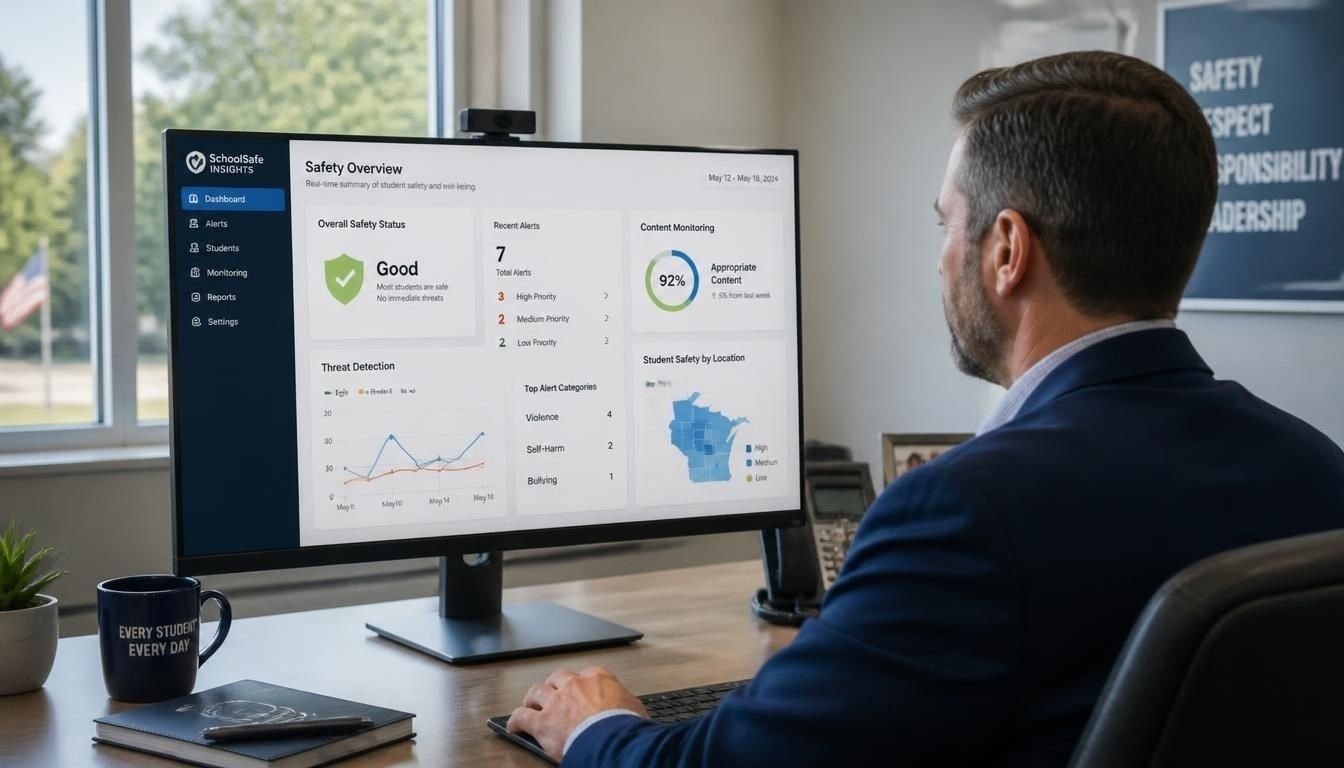
A content monitoring school safety platform can help schools identify concerning digital activity across school-managed devices and accounts. Depending on its capabilities, the technology may help staff identify warning signs involving bullying, threats, self-harm, violence or other student safety concerns.
For school administrators evaluating Wisconsin state funding content monitoring school safety platform options, the first step is to distinguish between funding for general school safety, emergency response, cybersecurity and student digital monitoring.
These categories have different purposes and purchasing requirements.
Key Takeaways
- Wisconsin provides targeted funding to help schools improve safety and protect students.
- State school safety grants do not automatically cover every content monitoring platform.
- Digital student monitoring can support early identification of concerning online behavior.
- Schools should verify eligible expenses before including software in a grant application.
- Districts should compare platform capabilities and funding requirements before purchasing technology.
Which Wisconsin School Safety Funding Programs Are Relevant?
The Wisconsin Department of Justice Office of School Safety administers several school safety funding opportunities. Not every program supports software subscriptions or ongoing digital monitoring services.
The following programs are particularly relevant when evaluating potential funding.
1. Wisconsin Act 109 Digital Mapping Grants
Wisconsin Act 109 supports the development of digital school building maps that can help law enforcement and emergency responders understand school facilities during an incident.
The program supports eligible digital mapping expenses rather than general student monitoring software.
Important details include:
- Eligible applicants include public school districts, private schools, charter schools and tribal schools.
- The project period runs from July 1, 2022, through June 30, 2028.
- Funding is provided through reimbursement.
- Digital mapping must support emergency response and situational awareness.
- Mapping data must be compatible with public safety platforms without requiring additional software purchases by public safety agencies.
The state reports that 397 Wisconsin schools and school districts received more than $6.2 million in awards during the 2022–2026 award period.
Schools should not assume that a content monitoring platform qualifies under this grant simply because it supports school safety. Its primary purpose is digital building mapping. wisdoj.gov+1
2. Critical Incident Stabilization Funds
Wisconsin also provides Critical Incident Stabilization funding to eligible schools and districts that need assistance responding to or recovering from serious incidents.
Qualifying situations may involve violence, criminal conduct or other unusual events that create significant trauma within a school community.
Potentially eligible expenses include:
- Emergency response services
- Student and staff reunification
- Mental health counseling
- Security staffing
- Facility repairs and improvements
- Post-crisis consulting
- Relevant training expenses
This funding is different from a standard technology purchasing grant. A school generally needs to have experienced a qualifying incident, and proposed expenses must meet the program requirements.
A school should contact the Office of School Safety before assuming that a digital monitoring subscription or new software purchase can be included in its request. wisdoj.gov+1
3. Speak Up, Speak Out Student Instructional Materials Grant
Wisconsin’s Speak Up, Speak Out initiative provides a confidential reporting channel where students and community members can report concerns involving someone who may be struggling or in danger.
Its former Student Instructional Materials Grant supported schools implementing the initiative through educational materials and activities promoting awareness of the reporting system.
However, the grant has closed.
Schools can still purchase instructional materials through the program’s store, but should not treat the former grant as an active funding opportunity for purchasing a new content monitoring platform. wisdoj.gov+1
Other Funding Sources That May Support Student Safety Technology
Wisconsin schools should also examine federal education funding and technology-related grant programs. These opportunities may provide additional options when state school safety grants do not match a proposed purchase.
4. Title IV, Part A Student Support and Academic Enrichment
Title IV, Part A is a federal education funding program that gives eligible school districts flexibility to support three major priorities:
- Well-rounded educational opportunities
- Safe and healthy school conditions
- Effective use of educational technology
Student safety initiatives may align with the safe and healthy school conditions priority.
A district considering content monitoring software could evaluate whether the proposed technology supports its approved student safety objectives and allowable activities.
Before using these funds, administrators should:
- Review the district’s Title IV, Part A allocation.
- Identify the relevant student safety objective.
- Explain how the platform supports that objective.
- Confirm whether software licensing and recurring subscription costs are allowable.
- Follow applicable district procurement and federal grant requirements.
Title IV, Part A does not automatically approve every student monitoring product. The district must establish that the proposed expense is allowable and properly connected to its funding plan. Milwaukee Public Schools
5. State and Local Cybersecurity Grant Program
Wisconsin participates in the State and Local Cybersecurity Grant Program. It provides eligible government organizations, including school districts, with funding for cybersecurity improvements.
Supported activities include:
- Multifactor authentication
- Managed detection and response
- Endpoint detection and response
- Extended detection and response
- Other approved cybersecurity improvements
However, cybersecurity software and student safety content monitoring are not interchangeable.
A platform that identifies concerning student behavior is not automatically an eligible cybersecurity expense. Districts should evaluate the actual purpose of the technology against the grant’s approved activities.
The FFY24 application deadline was October 30, 2026, which has passed as of November 2, 2026. Schools should monitor future funding announcements rather than assume another application window is open. det.wi.gov
6. Federal School Safety Enhancement Program
The federal School Safety Enhancement Program provides funding to state educational agencies to strengthen school safety systems.
Its FY2026 competition included an estimated $93 million in total funding.
Supported priorities included:
- Secure entry systems and interior door locks
- Security cameras and perimeter controls
- Visitor screening infrastructure
- Emergency communication systems
- Emergency response planning
- Training and preparedness exercises
An important limitation is that state educational agencies are the eligible applicants. Individual school districts and private schools cannot apply directly for these awards.
The FY2026 application deadline was July 28, 2026, and the competition is closed.
Wisconsin schools should therefore look for relevant state-level implementation opportunities rather than treating this as a direct software purchasing grant. U.S. Department of Education+1
How Content Monitoring Supports a School Safety Strategy
Funding eligibility is only one part of the purchasing decision. Schools must also establish why they need a content monitoring platform and how it will support their existing safety procedures.
A well-designed platform can provide additional visibility into digital environments that school staff may not be able to monitor manually.
Identifying Concerning Student Activity
Students use school-managed devices and accounts for communication, research, assignments and collaboration.
Concerning behavior may appear through different digital activities, including:
- Searches involving violence or self-harm.
- Messages containing threats or bullying.
- Cyberbullying through school-managed communication tools.
- Concerning language in documents or assignments.
- Repeated behavior that may require additional attention from trained staff.
Content monitoring technology can help identify potential warning signs and bring them to the attention of authorized school personnel.
However, an alert is not proof that a student intends to cause harm. Context and human review remain essential.
Supporting Earlier Intervention
A monitoring platform can help schools establish a more organized process for reviewing safety concerns.
For example, consider a student who repeatedly accesses content related to self-harm through a school-managed device.
A monitoring system may flag the activity and notify designated personnel. The school can then follow its established procedures to determine whether the situation requires additional support.
This approach can help staff respond to concerns before they develop into more serious situations.
Improving Communication Between School Staff
A useful platform should do more than generate alerts.
It should help authorized staff:
- Review reported concerns.
- Understand the context behind alerts.
- Assign follow-up responsibilities.
- Document actions taken.
- Coordinate with counselors and administrators.
- Maintain appropriate records.
These capabilities help connect digital monitoring with the school’s broader student safety procedures.
What Features Should Schools Evaluate Before Purchasing a Platform?
Not every content monitoring solution provides the same level of protection or administrative control.
A district should evaluate the technology according to its actual safety requirements rather than selecting software based on the number of advertised features.
| Platform feature | Why it matters |
|---|---|
| Content monitoring | Identifies potentially concerning digital activity |
| Threat detection | Helps flag threats and other serious warning signs |
| Bullying detection | Identifies potentially harmful student interactions |
| Self-harm detection | Helps identify content that may indicate a student needs support |
| Real-time alerts | Helps designated staff review urgent concerns |
| Alert prioritization | Helps staff distinguish urgent cases from lower-priority activity |
| Case management | Supports documentation and follow-up |
| Reporting dashboard | Gives administrators visibility into safety activity |
| Integration support | Helps connect with existing school technology |
| Privacy controls | Limits access to sensitive student information |
Why Alert Accuracy Matters
One of the most important considerations is how accurately a platform identifies concerning activity.
A system that produces too many irrelevant alerts can overwhelm school counselors and administrators.
For example, a student writing an academic report about violence may trigger a keyword-based alert even though the assignment presents no actual threat.
A stronger system should consider context, severity and other relevant signals.
Schools should ask vendors:
- How does the platform distinguish academic content from genuine warning signs?
- Can administrators adjust alert sensitivity?
- Are alerts categorized by severity?
- Can staff review the original context?
- How are false positives handled?
- Can the school measure alert accuracy over time?
The objective should be useful intervention rather than simply generating more alerts.
How Wisconsin Schools Can Prepare a Funding Request
Schools interested in Wisconsin state funding content monitoring school safety platform purchases should build a clear connection between their safety needs, proposed technology and funding requirements.
A well-prepared request should explain the problem the school wants to address and why the proposed solution is appropriate.
Step 1. Identify the School Safety Problem
Start by identifying the specific issue that requires attention.
Examples include:
- Limited visibility into student digital activity.
- Difficulty identifying cyberbullying.
- Delayed identification of concerning online behavior.
- Limited staff capacity to review digital safety concerns.
- Lack of an organized process for managing alerts.
The school should use its existing safety assessments and documented needs wherever possible.
Step 2. Define the Proposed Technology
Describe what the platform will actually do.
Include details about:
- Supported devices and applications.
- Types of content monitored.
- Threat detection capabilities.
- Alert delivery and prioritization.
- Staff access and permissions.
- Reporting and case management.
- Implementation and ongoing support.
Avoid describing every available feature as necessary. Focus on capabilities connected to the identified safety problem.
Step 3. Connect the Purchase to the Funding Objective
This is particularly important when applying for government funding.
A school must explain how the proposed expense fits the grant’s approved purpose.
For example, a digital monitoring subscription may support a student safety initiative, but that does not mean it qualifies under a grant specifically intended for emergency building mapping.
Administrators should obtain written confirmation from the funding agency when eligibility is unclear.
Step 4. Prepare a Realistic Budget
The budget should reflect the complete cost of implementation.
Consider:
- Initial setup and configuration.
- Annual software licensing.
- Per-student or per-device charges.
- Integration costs.
- Staff training.
- Technical support.
- Renewal expenses.
If a platform uses annual subscriptions, explain how the school plans to maintain access after the original funding period.
Step 5. Establish a Measurement Plan
Schools should determine how they will evaluate the platform after implementation.
Useful measures may include:
- Number of alerts reviewed.
- Time required to review urgent alerts.
- Percentage of alerts requiring follow-up.
- Staff response completion.
- Training participation.
- Documented intervention outcomes.
These measures should assess operational effectiveness rather than treating higher alert volumes as proof of improved safety.
How to Choose the Right Funding Route for a Monitoring Platform
The most important decision is matching the proposed technology to the actual purpose of a funding program.
A school should not purchase software first and attempt to justify it under an unrelated grant afterward.
Instead, compare the funding options against the proposed purchase.
| Funding route | Best application | Suitability for content monitoring |
|---|---|---|
| Wisconsin Act 109 | Digital emergency building mapping | Not a general monitoring grant |
| Critical Incident Stabilization | Recovery and eligible costs following a qualifying incident | Limited and requires approval |
| Speak Up, Speak Out materials | Student reporting awareness materials | Not an active software funding route |
| Title IV, Part A | Safe learning conditions and educational technology | Potentially relevant subject to approval |
| Cybersecurity Grant Program | Approved cybersecurity improvements | Not automatically suitable |
| Federal School Safety Enhancement | Statewide school safety improvements | No direct district application |
When Should a School Pursue State Funding?
State funding is worth investigating when the school has a clearly documented safety need and an available grant specifically permits the proposed expenditure.
For example, a district seeking funding for digital emergency maps should prioritize Act 109 requirements.
A district looking to improve student digital safety should investigate funding routes that support safe learning environments and technology.
When Should a School Consider District Funding?
District funding may be more practical when:
- No suitable grant is currently open.
- The software is needed before the next grant cycle.
- The proposed expense is not covered by available grants.
- The district wants to test a platform before expanding its use.
A district may also consider a limited pilot involving selected school-managed devices before committing to a district-wide subscription.
Five Questions to Ask Before Approving a Purchase
Before signing a contract, administrators should obtain clear answers to these questions:
- Does the funding program explicitly permit the proposed software expense?
- Does the platform support the school’s documented safety objectives?
- Can staff manage and investigate alerts effectively?
- Does the vendor provide appropriate student data protection and access controls?
- Can the district afford ongoing licensing and support after the initial funding period?
Schools should also review student privacy requirements, FERPA obligations, applicable state laws, vendor data retention policies and contractual responsibilities.
A platform should collect only the information needed for its intended purpose and restrict access to authorized personnel.
The best purchasing decision is one that satisfies the funding requirements while providing a practical and sustainable improvement to student safety.
Frequently Asked Questions
1. Does Wisconsin offer state funding for content monitoring school safety platforms?
Wisconsin offers several school safety funding programs, but there is no automatic grant entitlement specifically for purchasing student content monitoring software. Schools must identify an eligible funding opportunity and confirm that the proposed expense is permitted.
2. Can Wisconsin schools use Act 109 grants to purchase student monitoring software?
Generally, no. Act 109 funding is intended for digital school building mapping that improves emergency response and situational awareness for first responders. It should not be treated as general funding for student activity monitoring.
3. Can Title IV, Part A funding support a content monitoring platform?
Potentially. Title IV, Part A supports safe learning conditions and educational technology. However, the district must establish that the specific software expense is allowable and connected to an approved funding objective.
4. Who can apply for Wisconsin school safety grants?
Eligibility depends on the individual program. Wisconsin school safety funding opportunities may include public school boards, independent charter schools, private school governing bodies and tribal schools. Some programs have additional eligibility requirements.
5. Does Wisconsin provide funding for digital student safety?
Wisconsin supports different school safety initiatives, including confidential reporting, behavioral threat assessment and emergency preparedness. Funding availability and eligible expenses vary by program.
6. What should schools look for in a content monitoring platform?
Schools should evaluate threat detection, bullying identification, self-harm alerts, alert accuracy, reporting, case management, integration capabilities and student data privacy protections.
7. Can a school purchase content monitoring software using cybersecurity grants?
Not automatically. Cybersecurity grants focus on approved information security improvements. Student safety monitoring software must meet the specific grant’s requirements before it can be considered an eligible purchase.
8. Are Wisconsin school safety grants available for private schools?
Yes. Certain Wisconsin school safety programs accept applications from private school governing bodies. However, eligibility differs between grant opportunities and should be checked before applying.
9. What documentation should a school prepare before requesting funding?
Schools should prepare a documented safety need, proposed technology specifications, implementation plan, itemized budget, expected outcomes and relevant procurement documentation. Additional requirements depend on the funding program.
10. How can schools confirm whether a monitoring platform qualifies for funding?
Schools should contact the relevant funding agency with the platform’s product description, proposed costs and intended use. Written confirmation is preferable before entering into a purchasing agreement.
Choosing a Funding Strategy That Supports Long-Term Student Safety
Wisconsin schools have access to several school safety funding pathways, but each serves a different purpose. Digital building mapping, incident recovery, cybersecurity and student content monitoring should not be treated as interchangeable expenses.
For schools evaluating a content monitoring platform, the priority should be identifying an appropriate funding source, confirming software eligibility and selecting technology that supports practical intervention.
A sustainable approach combines suitable funding, reliable monitoring capabilities, trained staff, clear response procedures and responsible student data protection.
The goal is not simply to purchase another school technology product. It is to build a more effective process for identifying concerns and helping students receive appropriate support.