
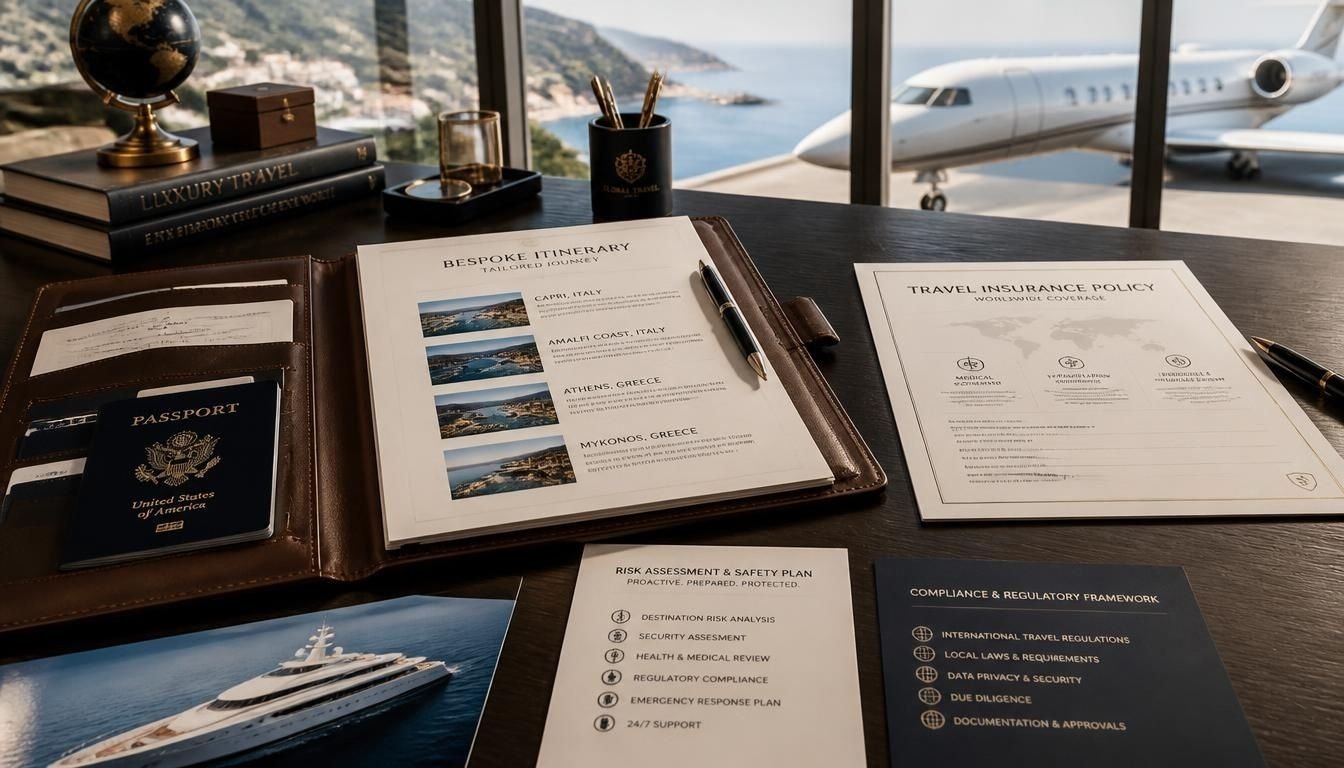
A luxury vacation involves more than premium hotels and private transportation. Travelers also need reliable suppliers, appropriate insurance, destination-specific safety planning and clear protection when unexpected events affect their trip.
A luxury bespoke itinerary safety regulatory insurance framework brings these responsibilities together. It provides a structured way to assess travel risks, verify service providers, understand regulatory obligations and prepare for emergencies without reducing the flexibility of a personalized experience.
For US travelers and luxury travel planners, this framework is particularly important when an itinerary includes international destinations, private aviation, yacht charters, remote resorts, adventure activities or multiple transportation providers.
The objective is not to eliminate every possible risk. It is to identify foreseeable problems, understand who is responsible and establish practical arrangements before the traveler departs.
Key Highlights
- Luxury travel planning requires safety checks for every destination and activity.
- Supplier verification helps reduce transportation, accommodation and activity-related risks.
- US travel businesses must understand applicable state seller-of-travel regulations.
- Travel insurance should match the actual itinerary and planned experiences.
- Emergency contacts, backup arrangements and clear contracts protect both travelers and travel planners.
What a Luxury Travel Safety Framework Should Cover
A well-designed safety framework should address the entire journey from the first booking to the traveler’s return home.
It should include five connected areas.
| Framework area | Main responsibility | Practical objective |
|---|---|---|
| Destination risk assessment | Evaluate location-specific risks | Identify potential safety concerns |
| Supplier verification | Check hotels and service providers | Reduce operational and service risks |
| Regulatory compliance | Review applicable travel laws | Protect customers and the travel business |
| Insurance protection | Match policies to travel arrangements | Reduce financial exposure |
| Emergency management | Prepare response and backup procedures | Maintain traveler safety during disruptions |
These areas should work together rather than operate as separate administrative tasks.
For example a private island vacation may require verified boat transportation, weather monitoring, emergency medical access, suitable evacuation coverage and an alternative accommodation arrangement.
A luxury itinerary should account for these details before the traveler arrives.
Destination Risk Assessment Before Confirming an Itinerary
Destination research is the first step in building a safe personalized travel plan.
A destination that appears suitable for luxury tourism may still present risks related to weather, transportation, healthcare access, political conditions or local regulations.
Review official travel advisories
US travelers should review the latest travel information published by the US Department of State.
Its advisory system uses four levels:
- Level 1: Exercise normal precautions.
- Level 2: Exercise increased caution.
- Level 3: Reconsider travel.
- Level 4: Do not travel.
An itinerary should not rely on a travel advisory alone. Planners should also examine specific regional conditions and the activities included in the trip.
For example a resort may operate in a generally stable country while a nearby region experiences transportation disruptions or security concerns.
Travel planners should review:
- Local crime and security conditions.
- Political demonstrations and civil unrest.
- Natural disasters and seasonal weather.
- Healthcare facilities and emergency access.
- Entry requirements and local laws.
- Transportation reliability.
- Communication availability in remote areas.
The US Department of State also provides the Smart Traveler Enrollment Program. US citizens and nationals can enroll to receive relevant embassy alerts and help the government contact them during emergencies. Travel.state.gov+1
Assess risks for individual experiences
A destination-level assessment is not enough for a bespoke itinerary.
Every major activity should receive its own safety review.
Consider the following examples:
| Luxury experience | Important safety checks |
|---|---|
| Private yacht charter | Vessel condition, qualified crew, weather and emergency equipment |
| Helicopter sightseeing | Operator credentials, aircraft maintenance and weather restrictions |
| Private safari | Licensed operator, trained guides and wildlife safety procedures |
| Scuba diving | Instructor qualifications, equipment and medical support |
| Mountain excursions | Guide experience, altitude risks and evacuation access |
| Remote island resort | Medical facilities, boat transfers and emergency communications |
| Private ground transportation | Driver qualifications, vehicle condition and insurance |
The objective is to understand what could go wrong and whether the supplier has a credible plan to manage it.
Build seasonal and environmental safeguards
Seasonal conditions can change the safety of an otherwise suitable itinerary.
Examples include:
- Hurricane season affecting Caribbean travel.
- Wildfire risks affecting certain Mediterranean destinations.
- Heavy snowfall affecting mountain transportation.
- Extreme heat affecting desert excursions.
- Monsoon conditions affecting island transfers and outdoor activities.
A planner should establish weather-related cancellation rules before confirming nonrefundable activities.
Where possible, include alternative experiences that preserve the quality of the trip without exposing travelers to unnecessary risks.
Supplier Verification and Operational Safety
Luxury travel depends on multiple service providers. A traveler may use one company for accommodation, another for transportation and several independent operators for activities.
The quality of the itinerary depends partly on how these providers are selected and monitored.
Verify the supplier before booking
A luxury travel planner should not select a supplier based only on photographs, online reviews or premium pricing.
Important verification steps include:
- Confirm the supplier’s legal business identity.
- Check applicable operating licenses and permits.
- Verify professional qualifications where required.
- Review insurance certificates and policy validity.
- Confirm vehicle, vessel or equipment maintenance procedures.
- Check emergency response arrangements.
- Review recent customer feedback and complaint patterns.
- Confirm cancellation and refund conditions.
For specialized services such as private aviation and yacht charters, verification should also cover the actual operator responsible for delivering the service.
A booking intermediary and the company physically operating the service may be different businesses.
That distinction matters when determining who carries responsibility for safety and insurance.
Establish minimum supplier requirements
A written supplier checklist makes verification more consistent.
| Requirement | Evidence to request |
|---|---|
| Business legitimacy | Registration or business documentation |
| Operating authority | Relevant licenses and permits |
| Professional competence | Staff qualifications and training records |
| Liability protection | Current insurance certificate |
| Equipment safety | Inspection and maintenance records |
| Emergency readiness | Written response procedures |
| Service reliability | Backup arrangements and contact details |
Not every supplier will have identical documentation. Requirements should reflect the activity and the laws of the destination.
Confirm responsibility between suppliers
Consider a seven-day itinerary involving a luxury hotel, private driver, helicopter transfer and yacht charter.
If the helicopter transfer is canceled because of poor weather, someone must coordinate the replacement transportation and communicate the change.
The itinerary should establish:
- Which company is responsible for each service.
- Who contacts the traveler during disruptions.
- Who arranges replacement transportation.
- Who handles refunds or additional expenses.
- Which party coordinates emergency assistance.
This avoids situations where different suppliers assume another company is responsible.
US Regulatory Requirements for Luxury Travel Businesses
The regulatory side of luxury travel planning is important for both customers and travel businesses.
There is no single federal seller-of-travel license that applies to every US travel advisor. However state registration laws and other business requirements may apply depending on the company’s location, business model and customers.
Understand seller-of-travel registration
California, Florida, Hawaii and Washington have seller-of-travel regulatory requirements.
The exact obligations differ by state.
For example:
California
California requires covered sellers of travel to register with the Attorney General’s Office. Registration and applicable consumer protection requirements should be reviewed before conducting regulated business. Office of the Attorney General+1
Florida
Florida requires covered sellers of travel to register annually with the Department of Agriculture and Consumer Services unless an exemption applies.
The requirements can include financial assurance through a surety bond. The department also establishes advertising and contract disclosure requirements. fdacs.gov+1
Washington
Washington requires covered travel sellers to obtain the appropriate seller-of-travel license. Financial security requirements can depend on the business’s annual gross income from Washington residents. Washington State Department of Licensing
Hawaii
Hawaii also regulates travel agencies and travel-related sales through state requirements. Businesses should check the applicable registration and financial requirements with the relevant state licensing authority.
A travel business should not assume that operating from another state automatically removes its obligations when selling to residents elsewhere.
The precise application of these laws depends on the business activities and statutory exemptions.
Review contracts and customer disclosures
Before collecting payment, a travel planner should provide clear written terms.
A customer agreement should explain:
- The services included in the itinerary.
- Total pricing and payment schedules.
- Nonrefundable deposits.
- Cancellation and amendment penalties.
- Supplier-specific terms.
- Responsibilities of the travel planner.
- Circumstances outside the planner’s control.
- Refund and dispute procedures.
- Insurance recommendations and limitations.
Customers should know whether they are purchasing a complete travel package or receiving separate bookings from individual suppliers.
This distinction can affect contractual responsibilities and consumer protection obligations.
Keep regulatory records organized
A compliant travel operation should maintain:
- Business registration records.
- Applicable seller-of-travel registrations.
- Supplier contracts.
- Insurance certificates.
- Customer agreements.
- Payment records.
- Booking confirmations.
- Required customer disclosures.
- Complaint and incident records.
These documents help demonstrate that the business has established consistent operating procedures.
Regulatory requirements can change. A qualified US travel attorney should review the business model and applicable state laws before a travel company begins selling regulated services.
Travel Insurance That Matches the Actual Itinerary
Travel insurance is one of the most important financial safeguards in luxury travel.
However buying a standard policy does not automatically protect every part of an expensive bespoke vacation.
A policy must match the trip’s actual costs, activities, destinations and potential medical needs.
Understand the main types of travel insurance
Different policies protect against different risks.
| Insurance type | What it generally covers | When it matters |
|---|---|---|
| Trip cancellation | Covered reasons for canceling before departure | Expensive prepaid bookings |
| Trip interruption | Covered events that interrupt an active trip | Multi-destination vacations |
| Travel medical insurance | Eligible medical expenses abroad | International travel |
| Medical evacuation | Eligible emergency medical transportation | Remote destinations |
| Baggage protection | Covered lost, stolen or damaged belongings | Trips involving valuable luggage |
| Travel delay | Eligible expenses caused by covered delays | Complex transportation schedules |
| Rental vehicle coverage | Eligible vehicle damage or loss | Self-drive travel |
Coverage varies by insurer and policy. These categories should not be treated as automatic benefits included in every comprehensive plan.
Calculate the actual nonrefundable trip exposure
Luxury travel can involve substantial advance payments.
For example a hypothetical itinerary might include:
| Expense | Prepaid amount |
|---|---|
| Private villa | $18,000 |
| Private aviation | $12,000 |
| Yacht charter | $8,000 |
| Private excursions | $4,000 |
| Total | $42,000 |
Illustrative figures only. These are not market price estimates.
The traveler should identify which payments are refundable and which are exposed to cancellation penalties.
Insurance decisions should be based on eligible nonrefundable expenses rather than simply the total vacation budget.
The policy should also account for any additional prepaid arrangements made after the original purchase.
Check exclusions before purchasing coverage
Policy exclusions can be particularly important for luxury travel.
Common areas requiring careful review include:
- Pre-existing medical conditions.
- Political unrest and government travel restrictions.
- Pandemics and certain disease-related events.
- High-risk recreational activities.
- Alcohol or drug-related incidents.
- Known events that existed before purchasing coverage.
- Unapproved changes to travel arrangements.
For example a traveler planning heli-skiing should not assume that ordinary travel medical insurance covers injuries associated with that activity.
The insurer should confirm the activity’s eligibility in writing before the traveler pays for the experience.NAIC+1
Understand Cancel For Any Reason coverage
Cancel For Any Reason coverage is an optional benefit offered by certain travel insurance plans.
It can provide greater flexibility when a traveler wants to cancel for a reason that does not qualify under standard covered cancellation provisions.
However it comes with limitations.
Important questions include:
- What percentage of eligible prepaid expenses is reimbursed?
- How soon must the policy be purchased?
- How early must the cancellation occur?
- Must all prepaid nonrefundable expenses be insured?
- Does the benefit apply to every traveler on the booking?
CFAR coverage generally reimburses only a portion of eligible trip expenses rather than the full amount.
It should not be treated as unrestricted cancellation protection. NAIC
Medical Evacuation and Emergency Healthcare Protection
Medical evacuation deserves special attention when an itinerary includes remote resorts, private islands, safari camps or destinations with limited medical facilities.
A traveler may have access to local medical treatment but still require transportation to a hospital with more advanced capabilities.
The CDC identifies medical evacuation as a separate insurance consideration because ordinary health insurance and travel disruption policies may not cover these costs.
Its 2026 Yellow Book guidance notes that medical evacuation costs can range from approximately $25,000 for transportation within North America to more than $250,000 for distant and remote locations. Actual costs depend on the circumstances and required transportation. CDC Yellow Book™+1
What to check in medical evacuation coverage
Before departure, confirm:
- Whether emergency medical transportation is included.
- Whether remote destinations are eligible.
- Whether transportation to another country is covered.
- Whether repatriation to the United States is available.
- Whether the insurer operates a 24-hour assistance center.
- Whether the insurer coordinates directly with hospitals.
- Whether medical evacuation requires prior authorization.
One important detail is that the insurer or assistance provider generally controls whether an evacuation meets the policy’s medical requirements.
A traveler should not assume that they can choose any hospital or request a private aircraft and automatically receive reimbursement.
Prepare for medical emergencies before departure
A medical preparation plan should include:
- The nearest suitable hospital at each major destination.
- Contact details for local emergency services.
- A list of available medical assistance providers.
- Relevant insurance identification and policy numbers.
- A plan for obtaining prescription medication.
- An emergency contact in the United States.
- A process for communicating medical emergencies to family members.
Travelers should also understand whether medical expenses must be paid upfront and reimbursed later.
This is particularly important in destinations where hospitals do not directly bill international insurance companies.
Emergency Response and Itinerary Contingency Planning
Even a carefully planned luxury vacation can experience unexpected disruptions.
Flights may be canceled. Weather conditions may prevent boat transfers. A hotel may become unavailable. An excursion may be suspended because of safety concerns.
A good framework prepares for these situations before they happen.
Create an emergency response structure
Every itinerary should identify who is responsible for coordinating assistance.
A basic response structure can include:
| Responsibility | Assigned party |
|---|---|
| Traveler communication | Lead travel advisor or designated contact |
| Medical assistance | Insurer’s emergency assistance provider |
| Local emergency response | Destination emergency services |
| Accommodation replacement | Hotel or travel operations team |
| Transportation replacement | Verified alternative supplier |
| Family communication | Authorized emergency contact |
The traveler should receive the relevant contact details before departure.
For higher-risk itineraries, a dedicated 24-hour assistance arrangement may be appropriate.
Develop backup arrangements for critical services
Backup planning should focus on services that could significantly affect traveler safety or the ability to continue the trip.
For example:
Private island vacation
- Primary transfer: Private boat.
- Alternative: Verified helicopter operator where available and suitable.
- Emergency arrangement: Confirmed medical transportation procedure.
Mountain luxury retreat
- Primary transportation: Private SUV.
- Alternative: Approved local transportation provider.
- Emergency arrangement: Access to appropriate medical facilities and weather-related evacuation procedures.
Multi-country European itinerary
- Primary transportation: Scheduled private transfers.
- Alternative: Verified replacement vehicle or suitable commercial transportation.
- Emergency arrangement: Updated hotel and transport contacts at each destination.
Alternative arrangements must be realistic. A backup provider should not be included simply because it appears in the itinerary document. Its availability and ability to deliver the service should be confirmed.
Establish clear communication procedures
Travelers should know how they will receive updates when something changes.
A practical communication protocol includes:
- A primary emergency contact.
- A secondary contact if the primary person is unavailable.
- Local emergency numbers.
- Insurer assistance details.
- Updated supplier contacts.
- An agreed method for urgent communication.
For remote travel, planners should consider whether mobile service, Wi-Fi or satellite communication is available.
The US Department of State recommends reviewing destination information and enrolling in STEP to receive embassy alerts during international travel. Travel.state.gov+1
Contracts, Liability and Financial Protection
A luxury travel agreement should make responsibilities clear before a traveler makes a significant payment.
This is especially important when several independent suppliers participate in one customized itinerary.
Define the travel planner’s responsibilities
The agreement should explain whether the business acts as:
- A travel advisor arranging separate bookings.
- A travel agency selling travel services.
- A tour operator assembling and selling a complete package.
- An intermediary connecting travelers with independent suppliers.
These roles may create different contractual and regulatory responsibilities.
The agreement should not suggest that the planner guarantees the performance of independent suppliers unless that responsibility has actually been accepted.
Review liability and insurance arrangements
A travel business should consider appropriate commercial insurance based on its actual operations.
Potential coverage includes:
| Business insurance | Purpose |
|---|---|
| Professional liability | Protection against certain claims involving professional services |
| General liability | Certain third-party bodily injury and property damage claims |
| Cyber liability | Certain costs associated with data breaches and cyber incidents |
| Workers’ compensation | Employee-related workplace injury obligations where applicable |
| Commercial auto | Covered business vehicle-related risks |
A professional liability policy may also be called errors and omissions insurance.
The actual protection depends on the policy wording, exclusions, limits and applicable law.
A travel planner should also check whether subcontractors and independent agents are covered under the business’s existing insurance.
Avoid relying on liability waivers alone
A liability waiver can explain certain risks and establish the traveler’s acknowledgment of specific conditions.
However it does not automatically remove all legal responsibility.
Its enforceability depends on the wording, circumstances and applicable jurisdiction.
A better approach combines:
- Clear customer agreements.
- Verified suppliers.
- Appropriate insurance.
- Documented safety procedures.
- Transparent cancellation terms.
- Incident reporting and response procedures.
This creates a more complete protection system than relying on a signed waiver alone.
Expert Decision Framework for Evaluating a Luxury Travel Protection Plan
A traveler or luxury travel planner should evaluate the framework based on the actual itinerary rather than selecting the most expensive insurance package or the largest number of safety services.
The following decision process helps identify the protection that matters most.
Step 1. Identify the highest-risk itinerary component
Start with the activity or destination that could create the greatest safety or financial exposure.
Examples include:
- Remote island accommodation.
- Helicopter transportation.
- Private yacht excursions.
- High-altitude activities.
- Multi-country travel with several connections.
These components may require more detailed supplier checks and specialized coverage.
Step 2. Separate financial risks from physical safety risks
These are different problems and require different solutions.
| Risk | Appropriate protection |
|---|---|
| Nonrefundable hotel cancellation | Eligible trip cancellation coverage |
| Medical emergency abroad | Travel medical insurance |
| Serious injury in a remote area | Suitable medical evacuation coverage |
| Unsafe transportation supplier | Supplier verification and alternative transport |
| Weather-related excursion cancellation | Flexible booking terms and eligible insurance |
| Supplier failure | Contractual protection and applicable financial safeguards |
Insurance cannot replace proper operational safety measures.
Likewise a verified supplier cannot protect a traveler from every financial loss.
Step 3. Match coverage to the experience
The policy should reflect the actual activities rather than a generic description of the vacation.
For example a standard luxury resort vacation may require different coverage from an expedition involving scuba diving, helicopter transfers and remote accommodation.
Ask the insurer to confirm whether each activity is covered.
Step 4. Compare the actual policy terms
Do not compare insurance plans only by their advertised coverage limits.
Review:
- Medical expense limits.
- Emergency evacuation limits.
- Deductibles.
- Exclusions.
- Pre-existing condition provisions.
- Cancellation reimbursement.
- Claims documentation.
- Emergency assistance availability.
A lower-priced policy may offer sufficient protection for a straightforward trip but inadequate coverage for a complex expedition.
Step 5. Confirm the operational backup plan
Before final payment, make sure the itinerary has realistic alternatives for critical services.
If a supplier cannot deliver an essential service, the traveler should know what happens next.
This includes the replacement provider, potential additional costs and responsibility for arranging the change.
Which protection approach fits your itinerary?
| Itinerary type | Recommended approach |
|---|---|
| Luxury city and resort vacation | Supplier verification, cancellation coverage and medical protection |
| Private yacht or island vacation | Vessel checks, weather contingencies and evacuation coverage |
| Adventure luxury travel | Activity-specific medical coverage and qualified operators |
| Multi-country private itinerary | Comprehensive travel disruption planning and emergency coordination |
| Remote expedition | Advanced medical evacuation planning and communication backups |
The strongest approach is one where insurance, supplier verification, legal documentation and emergency procedures work together.
A comprehensive plan should also be reviewed whenever the traveler changes destinations, activities or transportation arrangements.
Luxury Bespoke Itinerary Safety Checklist Before Departure
A final review helps ensure that the arrangements made during planning are still valid when the traveler is ready to leave.
Use this checklist for the final itinerary review.
- Destination advisories and entry requirements reviewed.
- Seasonal weather and environmental risks assessed.
- Accommodation and transportation providers verified.
- Relevant supplier licenses and insurance confirmed.
- Activity-specific safety requirements checked.
- Customer contract and cancellation conditions provided.
- Travel medical coverage reviewed.
- Medical evacuation arrangements confirmed where needed.
- Nonrefundable expenses reviewed against insurance coverage.
- Emergency contacts and local medical facilities identified.
- Alternative transportation and accommodation arrangements confirmed.
- Traveler documents and insurance details shared securely.
- Final itinerary and supplier contacts provided to the traveler.
This review should be repeated when a major booking or itinerary change occurs.
FAQs
What is a luxury bespoke itinerary safety regulatory insurance framework?
A luxury bespoke itinerary safety regulatory insurance framework is a structured approach to managing travel safety, legal responsibilities, supplier risks and insurance protection. It helps ensure that customized travel arrangements have suitable safeguards before and during the trip.
Is travel insurance necessary for luxury vacations?
Travel insurance is not legally required for every vacation. However it can provide important financial and medical protection when a trip involves expensive prepaid bookings, international destinations or activities with additional risks.
What insurance should a luxury travel itinerary include?
Depending on the itinerary, relevant coverage may include trip cancellation, trip interruption, travel medical expenses, emergency medical evacuation, baggage protection and activity-specific coverage.
Do US travel advisors need a federal travel agency license?
There is no single federal travel agency license covering all US travel advisors. However certain states have seller-of-travel registration requirements. California, Florida, Hawaii and Washington have specific regulatory programs that businesses should review.
Does standard travel insurance cover private yacht charters?
Not automatically. Coverage depends on the policy and the circumstances of the charter. Travelers should confirm whether the relevant vessel activity, cancellation exposure and medical evacuation arrangements are covered.
How does medical evacuation insurance protect luxury travelers?
Medical evacuation insurance can cover eligible emergency transportation when suitable medical treatment is unavailable locally. Depending on the policy, this may involve transportation to another country or a more suitable medical facility.
What should a travel planner verify before recommending a luxury supplier?
A planner should check the supplier’s legal identity, applicable licenses, insurance, professional qualifications, equipment maintenance, emergency procedures and service history.
How often should a bespoke travel safety plan be reviewed?
The plan should be reviewed before departure and whenever significant itinerary changes occur. Additional reviews may be appropriate when destination conditions, weather risks or supplier arrangements change.
Can a liability waiver protect a luxury travel agency from every claim?
No. A waiver cannot automatically eliminate legal responsibility. Its enforceability depends on applicable law and the specific circumstances. Appropriate insurance, supplier verification and clear contracts remain important.
Why is a luxury bespoke itinerary safety regulatory insurance framework important for remote travel?
Remote destinations can have limited medical facilities, transportation options and emergency response resources. A luxury bespoke itinerary safety regulatory insurance framework helps planners identify these limitations and arrange suitable medical, transportation and financial safeguards before the traveler arrives.
Building a Reliable Protection Plan Around Every Luxury Experience
A luxury itinerary should be judged by more than the quality of its hotels, private transfers and exclusive experiences.
Its reliability also depends on whether the people arranging the trip have considered what happens when a supplier fails, weather interrupts transportation or a traveler needs urgent medical assistance.
For a straightforward resort vacation, standard supplier checks and suitable travel insurance may provide an appropriate foundation. For private aviation, yacht charters and remote expeditions, more extensive verification and emergency arrangements are necessary.
The most important decision is to match every safeguard to the actual risk. Travelers should understand their insurance limitations, planners should establish clear responsibilities and suppliers should demonstrate that they can deliver their services safely.
When these elements are addressed before departure, a personalized luxury experience can offer both exclusivity and a more dependable level of protection.