
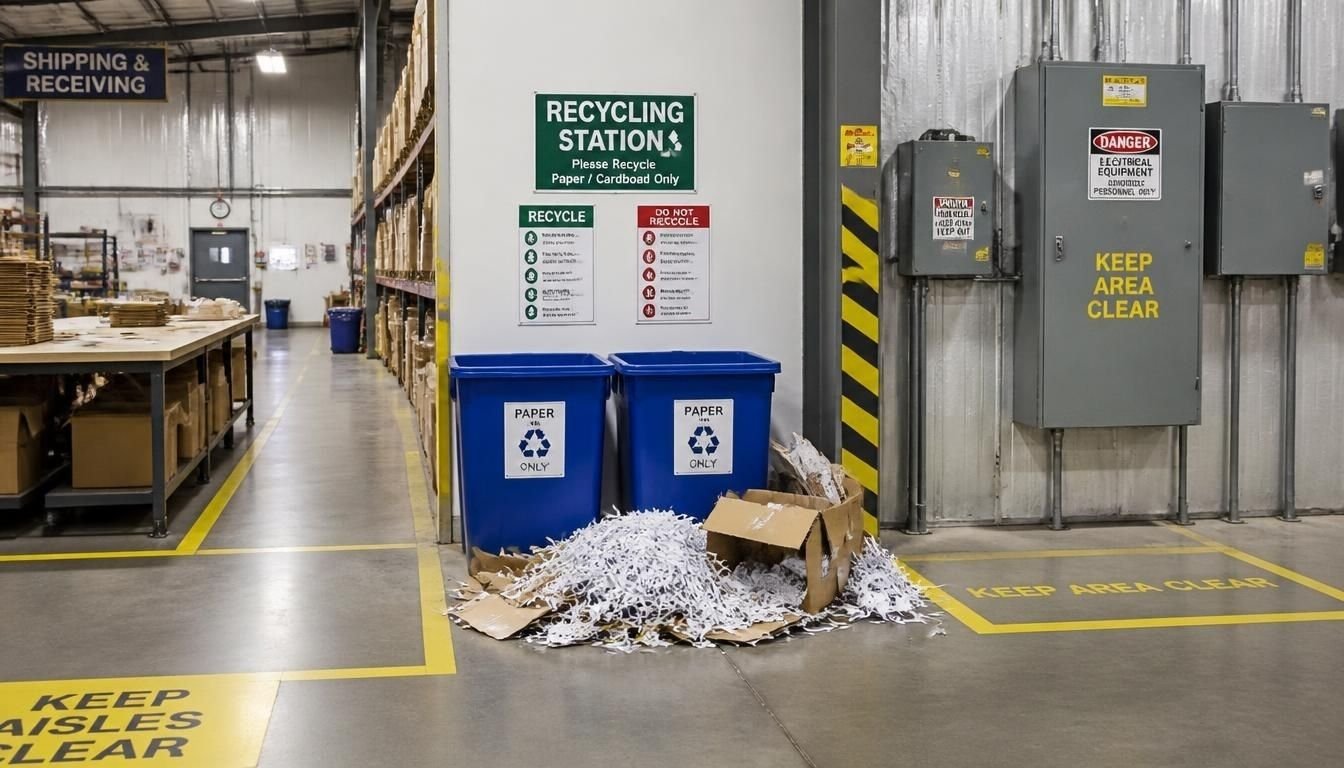
Paper scraps may look harmless in a warehouse, but accumulated paper waste can create a serious fire hazard. Packaging areas cutting stations shipping departments and storage aisles often generate small amounts of paper throughout the day. When employees leave these materials on floors shelves or around equipment the combustible load can increase without anyone noticing.
Visual control safety warehouse paper scraps fire risk focuses on making these hazards easy to identify and correct. It uses visible signs designated waste areas floor markings inspection boards and clear housekeeping rules to help employees recognize unsafe conditions.
The goal is not simply to keep a warehouse looking clean. It is to create a system that helps workers identify paper waste quickly understand where it belongs and take corrective action before a small housekeeping problem becomes a fire safety concern.
Why Paper Scraps Create Fire Hazards in Warehouses
Paper is a combustible material. Even when individual scraps are small they can contribute to a fire when they collect around equipment or combine with other combustible materials.
Several warehouse activities create regular paper waste:
- Cutting and trimming cardboard packaging.
- Removing shipping labels and packing slips.
- Opening cartons and separating packaging materials.
- Preparing customer orders for shipment.
- Printing inventory labels and warehouse documents.
- Damaging or discarding paper-based packaging.
The problem often develops gradually. Employees may leave a few scraps beside a workstation because they plan to clean them later. Other workers add more waste and the area eventually becomes a larger accumulation point.
Common warehouse locations where paper waste collects
| Warehouse location | Potential problem |
|---|---|
| Packing stations | Paper scraps collect during packaging activities |
| Conveyor systems | Paper becomes trapped near moving equipment |
| Shelving units | Loose packaging remains on shelves and behind stored materials |
| Shipping docks | Discarded labels and cardboard accumulate during dispatch |
| Electrical equipment | Combustible waste may collect near potential ignition sources |
| Storage corners | Waste remains unnoticed because these areas receive less attention |
| Waste collection points | Containers become overloaded or waste spills onto the floor |
Paper waste should also be evaluated alongside cardboard storage plastic packaging wooden pallets and other combustible materials.
Paper scraps and combustible paper dust are different hazards
It is important to distinguish ordinary paper scraps from fine combustible dust.
Large pieces of paper and cardboard primarily contribute to the available fuel in a warehouse fire. Fine paper dust can present an additional fire or explosion hazard when it becomes suspended in air at a sufficient concentration and encounters an ignition source.
Paper dust can develop through certain cutting shredding grinding and recycling operations.
Facilities that generate significant quantities of fine paper dust should not treat the issue as ordinary housekeeping alone. A qualified professional may need to evaluate the material and process for combustible dust hazards.
How Visual Controls Help Prevent Paper Scrap Fire Risks
Visual controls make warehouse safety conditions easier to understand without requiring employees to remember complicated instructions.
A worker should be able to recognize where paper waste belongs where it should not accumulate and what action to take when an unsafe condition appears.
The most useful controls combine physical markings with clear operating procedures.
1. Mark designated paper waste collection areas
Every department that generates paper waste should have an appropriate collection point.
Use visible signs and floor markings to identify:
- Paper and cardboard recycling stations.
- General waste collection areas.
- Temporary packaging waste locations.
- Approved container positions.
- Areas that must remain clear of combustible waste.
Place collection stations where employees can reach them easily without blocking forklift routes or emergency access.
Avoid placing waste containers near electrical panels heat-producing equipment or other ignition sources unless the location has been evaluated and approved for that purpose.
2. Use clear labels on waste containers
Employees should not have to guess which container accepts paper scraps.
Use large and readable labels that identify the material and disposal requirements.
Useful labels include:
- PAPER WASTE
- CARDBOARD RECYCLING
- GENERAL WASTE
- KEEP AISLES CLEAR
- DO NOT OVERFILL
- REPORT UNSAFE CONDITIONS
Labels should remain visible when containers are in use. Replace damaged signs and remove outdated instructions.
Where different materials require separate disposal procedures make those differences clear.
3. Establish visible housekeeping standards
A warehouse needs a consistent definition of acceptable housekeeping.
Employees should understand what a clean packing station or storage area looks like.
For example:
Acceptable condition
- Work surfaces are free from unnecessary paper scraps.
- Waste is inside designated containers.
- Floors are clear of loose packaging.
- Storage corners are free from discarded materials.
- Emergency access and equipment areas remain unobstructed.
Unacceptable condition
- Paper scraps are scattered across the floor.
- Cardboard is stored beside electrical equipment.
- Waste containers are overflowing.
- Packaging materials are left underneath workstations.
- Scrap paper is accumulating behind shelving.
Use photographs of acceptable and unacceptable conditions to make these expectations easier to follow.
4. Keep ignition sources separate from combustible waste
Visual waste controls should identify locations where paper accumulation could create a more serious fire hazard.
Potential ignition sources include:
- Damaged electrical wiring.
- Overheated motors and bearings.
- Heat-producing machinery.
- Welding and cutting operations.
- Open flames and smoking materials.
- Electrical equipment that develops faults.
Employees should never use floor markings as a substitute for approved equipment clearances or fire protection requirements.
The facility should establish appropriate separation and storage arrangements through its fire prevention plan and applicable fire safety requirements.
Building a Visual Inspection System for Paper Waste
Visual controls become more effective when employees use them as part of a regular inspection process.
A sign or colored floor marking cannot prevent waste accumulation if nobody checks whether the system is working.
A practical inspection system should identify where paper waste develops and who is responsible for correcting it.
Identify high-risk inspection areas
Start by reviewing the warehouse layout.
Identify departments with regular paper waste generation and locations where combustible materials could collect unnoticed.
A useful inspection priority list includes:
- Packaging and carton preparation stations.
- Conveyor belts and material handling equipment.
- Electrical and mechanical equipment areas.
- Waste collection stations.
- Storage racks and shelving corners.
- Shipping and receiving docks.
- Areas around emergency exits and fire protection equipment.
The inspection frequency should reflect waste generation rates and the level of fire risk in each area.
A busy packaging department may require several checks during a shift while a low-activity storage area may need less frequent attention.
Create a simple visual inspection checklist
A checklist helps supervisors identify recurring housekeeping problems instead of relying on general observations.
| Inspection item | Acceptable condition | Required action |
|---|---|---|
| Packing stations | No loose paper accumulation | Remove scraps |
| Waste containers | Properly used and not overflowing | Empty or replace |
| Electrical areas | No unauthorized combustible storage | Remove waste and report concerns |
| Storage racks | No unnecessary paper accumulation | Clean affected areas |
| Conveyor equipment | No trapped packaging waste | Follow approved cleaning procedure |
| Emergency access | Clear and unobstructed | Restore required access |
| Recycling stations | Waste placed in correct containers | Correct disposal practices |
Record inspection findings and assign responsibility for unresolved issues.
Use a visual safety board
A visual safety board can help supervisors communicate housekeeping performance across different warehouse departments.
A useful board can display:
- Department inspection status.
- Outstanding housekeeping issues.
- Assigned corrective actions.
- Responsible employees or supervisors.
- Inspection dates.
- Repeated paper waste accumulation locations.
Use simple status indicators such as green for acceptable conditions and red for unresolved problems.
The colors should be explained on the board rather than assumed to have a universal safety meaning.
The board should display actual inspection results. It should never show a department as compliant simply because an inspection was scheduled.
Safe Paper Scrap Collection and Disposal Procedures
Visual identification is only one part of controlling combustible waste. Warehouses also need appropriate collection and disposal procedures.
Select suitable waste containers
Waste containers should be:
- Suitable for the type and volume of waste.
- Easy for employees to access.
- Clearly labeled.
- Maintained in good condition.
- Emptied before they become overloaded.
- Positioned away from identified ignition hazards.
Where a fire hazard assessment identifies a need for covered or noncombustible waste containers the facility should use containers appropriate to that assessment.
Oily rags and other materials that can self-heat require separate approved handling and storage arrangements. They should not be mixed with ordinary paper waste.
Establish a regular waste removal schedule
Waiting until a waste container is completely full can allow unnecessary combustible material to accumulate.
A suitable removal schedule should consider:
- Daily paper waste generation.
- Department operating hours.
- Container capacity.
- Distance to the designated waste collection area.
- Fire risk around the collection location.
High-volume packaging areas may need waste removal several times during a shift.
The schedule should be based on actual operating conditions rather than an arbitrary universal time limit.
Prevent waste accumulation during cleaning
Employees should remove loose paper and cardboard using approved housekeeping methods.
For ordinary paper scraps this generally involves collecting the material and placing it in the correct waste container.
Facilities handling fine combustible paper dust need additional precautions.
Do not assume that compressed air or an ordinary vacuum is suitable for combustible dust cleanup. Airborne dust can create a more dangerous condition. The cleaning equipment and method should be selected through the facility’s hazard assessment.
Employee Responsibilities and Warehouse Safety Training
A visual safety system only works when employees understand their responsibilities.
Workers should receive practical instructions about identifying paper waste hazards and following approved disposal procedures.
Training should cover the following areas.
Recognizing unsafe paper accumulation
Employees should know how to identify:
- Paper scraps around electrical equipment.
- Overloaded waste containers.
- Cardboard stored in unauthorized locations.
- Loose packaging near machinery.
- Paper waste blocking access routes.
- Fine dust accumulating around equipment.
Workers should also understand the difference between normal packaging waste and potentially hazardous combustible dust.
Following disposal procedures
Employees should know where paper waste belongs and how frequently it must be removed.
New employees should receive this information during initial workplace training.
Supervisors should reinforce procedures when employees change departments or begin working with equipment that generates different types of waste.
Reporting unsafe conditions
Employees should have a clear reporting process for hazards they cannot correct themselves.
For example a worker who notices paper waste accumulating near an electrical panel should report it immediately rather than moving electrical equipment or attempting an unauthorized repair.
Supervisors should assign corrective actions and confirm that the hazard has been addressed.
Measuring Whether Visual Controls Are Working
A warehouse can install signs and waste containers without achieving meaningful safety improvements.
The effectiveness of the system should be measured through actual workplace conditions.
Useful performance indicators include:
| Performance indicator | What it measures |
|---|---|
| Housekeeping inspection results | Whether departments meet established cleaning standards |
| Waste container overflow incidents | Whether collection capacity and removal schedules are adequate |
| Corrective action completion | Whether reported hazards are resolved |
| Repeat accumulation locations | Whether underlying problems remain unresolved |
| Employee hazard reports | Whether workers identify and communicate unsafe conditions |
| Inspection completion | Whether required safety checks are being performed |
These measurements help identify patterns.
For example if one packaging department repeatedly reports overflowing paper containers the problem may involve insufficient container capacity or an ineffective waste removal schedule.
Increasing employee reminders alone would not address the underlying issue.
What US Warehouse Safety Requirements Say About Combustible Waste
Warehouse operators in the United States should understand the OSHA requirements that apply to housekeeping and fire prevention.
Several federal standards are particularly relevant.
| OSHA requirement | Main safety responsibility |
|---|---|
| 29 CFR 1910.22 | Maintain workplaces and walking surfaces in clean and orderly conditions |
| 29 CFR 1910.176(c) | Keep storage areas free from material accumulations that create fire or other hazards |
| 29 CFR 1910.39 | Include procedures for controlling combustible waste in applicable fire prevention plans |
| 29 CFR 1910.178 | Follow applicable powered industrial truck safety requirements |
These requirements address different aspects of warehouse safety.
For example 29 CFR 1910.176(c) specifically addresses hazardous material accumulation in storage areas. Section 1910.22 addresses general workplace housekeeping and inspection requirements.
Section 1910.39 identifies combustible waste accumulation control as an element of an applicable fire prevention plan.
Not every warehouse operation has identical requirements. Employers should determine which standards apply to their activities and facility conditions.
Additional considerations for combustible paper dust
Warehouses involved in paper recycling shredding or other dust-generating processes may need a more detailed combustible dust assessment.
OSHA identifies paper among materials that can produce combustible dust.
The hazard depends on factors such as particle size concentration dispersion and ignition sources. Ordinary visible paper scraps should not automatically be classified as an explosive dust hazard.
Where combustible dust is present a facility may need to evaluate:
- Dust collection equipment.
- Ventilation and ductwork.
- Hidden dust accumulation.
- Electrical equipment suitability.
- Ignition source controls.
- Approved housekeeping methods.
A qualified fire protection or combustible dust professional should evaluate these conditions where necessary.
Which Visual Controls Should a Warehouse Implement First?
Not every warehouse needs an expensive digital safety management system.
The best approach depends on the amount of paper waste generated the layout of the facility and the risks identified during inspection.
Visual control safety warehouse paper scraps fire risk should be addressed through controls that employees can understand and supervisors can verify.
The following comparison helps determine where to start.
| Visual control | Best application | Main benefit | Limitation |
|---|---|---|---|
| Floor markings | Waste collection and storage zones | Makes approved locations visible | Does not remove waste |
| Container labels | Paper and cardboard disposal | Reduces incorrect disposal | Requires regular monitoring |
| Photo standards | Packing and storage departments | Shows acceptable housekeeping | Needs updated examples |
| Inspection checklists | Routine warehouse inspections | Improves accountability | Depends on consistent completion |
| Safety boards | Multiple departments | Makes problems and actions visible | Can become outdated |
| Digital inspection systems | Large or multi-site facilities | Supports reporting and trend tracking | Requires setup and employee training |
Which approach makes sense for different warehouses?
Small warehouses
Start with clearly labeled waste containers floor markings and a simple daily housekeeping checklist.
These controls are relatively easy to implement and maintain.
Medium-sized distribution centers
Introduce department-specific inspection checklists and visual safety boards.
Assign supervisors to review recurring waste accumulation and verify corrective actions.
Large warehouses and recycling facilities
Combine visual controls with documented fire prevention procedures and risk-based inspections.
Facilities handling fine paper dust should also consider a professional combustible dust assessment.
Five questions to ask before implementing a visual control system
Before investing in new signs equipment or software consider:
- Which departments generate the most paper and cardboard waste?
- Are collection containers located close enough to workstations?
- Can employees identify unsafe waste accumulation without assistance?
- Are potential ignition sources and combustible storage locations properly evaluated?
- Can supervisors verify that reported problems are corrected?
If these questions cannot be answered clearly the warehouse should address those gaps before investing in more complicated monitoring systems.
FAQs
1. Why are paper scraps a fire risk in warehouses?
Paper is combustible and can contribute to fire growth when it accumulates near ignition sources. Large amounts of discarded paper and cardboard can increase the available fuel in a warehouse.
2. How does visual control safety warehouse paper scraps fire risk?
It helps employees identify paper accumulation through visible signs floor markings labeled containers and inspection checklists. These controls make it easier to recognize unsafe conditions and follow consistent disposal procedures.
3. What are the best visual controls for warehouse paper waste?
The most useful controls include:
- Clearly labeled paper waste containers.
- Marked disposal locations.
- Housekeeping inspection checklists.
- Acceptable and unacceptable condition photographs.
- Department safety boards.
The right combination depends on warehouse size and operating conditions.
4. How often should warehouse employees inspect paper waste areas?
Inspection frequency should reflect how quickly waste accumulates and the level of fire risk. High-volume packaging stations may require several inspections during a shift while other areas may need less frequent checks.
5. Can paper dust cause a warehouse fire or explosion?
Yes. Fine paper dust can be combustible and may create a fire or deflagration hazard when dispersed in air at a sufficient concentration and exposed to an ignition source. Facilities generating this type of dust need appropriate hazard assessments and controls.
6. Where should paper scrap collection containers be placed?
Containers should be located in accessible designated areas that do not obstruct aisles emergency exits or fire protection equipment. Their positions should also account for nearby electrical equipment and other potential ignition sources.
7. What OSHA rules apply to paper waste accumulation in warehouses?
Relevant requirements include 29 CFR 1910.22 for workplace housekeeping 29 CFR 1910.176(c) for storage area housekeeping and 29 CFR 1910.39 for applicable fire prevention plans.
8. Who is responsible for controlling paper scrap fire hazards?
Warehouse management is responsible for establishing appropriate safety procedures and providing necessary controls. Supervisors monitor housekeeping conditions while employees follow disposal procedures and report unsafe accumulation.
Keep Paper Waste Visible and Under Control
Effective warehouse fire prevention requires more than removing paper scraps after they become noticeable.
The most reliable approach combines clearly identified waste collection areas routine inspections appropriate disposal procedures and employee accountability.
Start with departments that generate the most paper waste. Make collection locations easy to recognize and establish inspection procedures based on actual accumulation rates. Review repeated problems to determine whether container capacity staffing or waste removal arrangements need improvement.
Visual controls provide the daily structure that makes these practices easier to follow. When employees can recognize unsafe conditions and know exactly what action to take warehouse housekeeping becomes a practical part of fire risk prevention.