Hiring a migrant domestic worker in Singapore comes with financial and legal responsibilities. One of the most important is arranging suitable insurance before the helper arrives.
Understanding how maid insurance works Singapore employer guide requirements helps employers know what protection they must purchase, which expenses an insurer may cover and what costs they may still need to pay themselves.
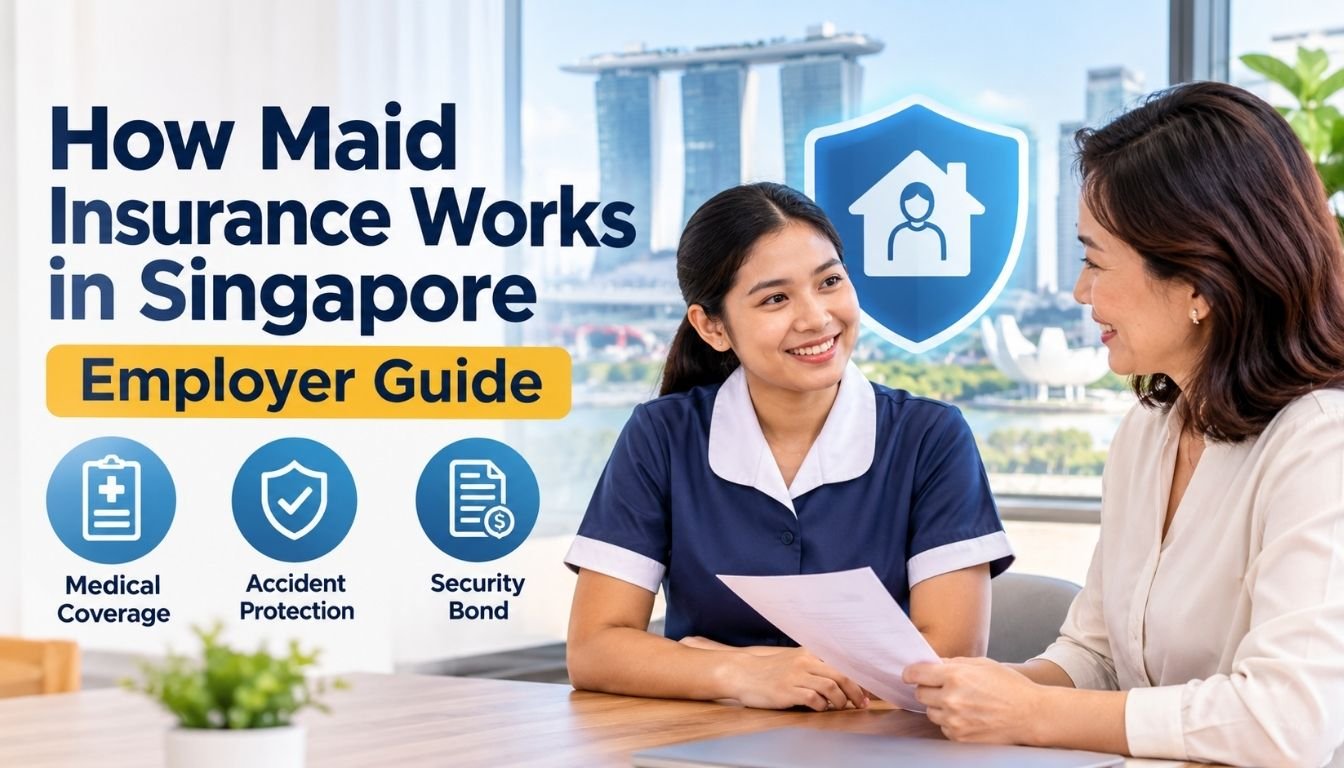
Maid insurance generally combines medical insurance and personal accident insurance. Employers of non-Malaysian helpers must also arrange a S$5,000 security bond. These requirements serve different purposes and should not be treated as interchangeable.
What Does Maid Insurance Cover in Singapore?
Maid insurance is designed to protect both the migrant domestic worker and the employer against specific financial risks.
However, each component has a different purpose.
1. Medical insurance
Medical insurance covers eligible inpatient treatment and day surgery expenses incurred by the helper in Singapore.
The minimum requirements include:
- At least S$60,000 in annual coverage.
- Coverage for inpatient hospital treatment.
- Coverage for day surgery.
- Compliance with MOM’s requirements for individual coverage sub-limits.
This insurance applies even when a medical condition is not related to the helper’s work.
For example, if your helper develops an illness and requires hospital admission, the policy may pay eligible hospital expenses according to its terms.
Medical insurance does not automatically cover every outpatient consultation, dental procedure or medical service. Employers should check the benefits and exclusions before purchasing a plan.
2. Personal accident insurance
Personal accident insurance provides financial compensation if the helper suffers permanent disability or dies because of an accident.
The minimum required sum assured is S$60,000.
Unlike medical insurance, this coverage does not primarily pay hospital bills. It provides a lump-sum benefit to the helper or her designated beneficiaries.
For example, if a serious accident results in permanent disability, the insurer assesses the circumstances and pays compensation according to the policy.
Employers should check the policy’s definition of permanent disability and how compensation is calculated.
3. Security bond
A security bond is a separate financial guarantee provided to the Ministry of Manpower.
Employers must arrange a S$5,000 security bond for each non-Malaysian migrant domestic worker.
It is important to understand that the security bond is not ordinary medical insurance.
It protects the government’s interests by ensuring that employers and helpers comply with Work Permit conditions.
For example, an employer may face bond forfeiture if they fail to pay the helper’s salary on time or do not send her home when her Work Permit expires or is cancelled.
The bond can be purchased through a bank or insurance company. An insurer may issue a guarantee instead of requiring the employer to deposit the full S$5,000 in cash.Ministry of Manpower Singapore+1
Singapore Maid Insurance Requirements at a Glance
The following table summarizes the main requirements employers should understand before hiring a helper.
| Insurance or requirement | Minimum requirement | Main purpose |
|---|---|---|
| Medical insurance | S$60,000 annually | Inpatient treatment and day surgery |
| Personal accident insurance | S$60,000 sum assured | Accidental death or permanent disability |
| Security bond | S$5,000 | Guarantee of Work Permit compliance |
| Employer responsibility | Employer pays | Insurance and bond costs cannot be passed to the helper |
Important: The security bond requirement does not apply to Malaysian helpers. Medical and personal accident insurance are still required.
The medical insurance requirements introduced in July 2023 and July 2025 also affect how claims, exclusions and hospital payments are handled.Ministry of Manpower Singapore+1
How Medical Insurance Claims Work
Understanding the claims process helps employers respond quickly when a helper needs hospital treatment.
The process generally involves the following steps.
Step 1. Arrange medical treatment
If your helper becomes seriously ill or needs hospital treatment, arrange an appropriate medical assessment.
For emergency situations, prioritize medical attention rather than delaying treatment to contact the insurer.
Step 2. Contact the insurance provider
Inform the insurer about the hospitalization or planned day surgery.
The insurer may ask for:
- Helper’s identification and policy details.
- Hospital admission information.
- Medical reports.
- Doctor’s diagnosis.
- Estimated treatment costs.
- Other supporting documents.
The exact requirements depend on the insurer and the type of claim.
Step 3. The insurer assesses the claim
The insurer reviews the medical condition, treatment and policy terms.
It checks whether the expenses are eligible and whether any exclusions or limits apply.
For medical insurance policies starting on or after 1 July 2025, insurers must pay hospitals directly once a claim is admissible.
This can reduce the need for employers to pay the full eligible hospital bill upfront and wait for reimbursement.
Step 4. Understand the co-payment
The enhanced medical insurance framework includes a shared payment arrangement for larger claims.
For claim amounts above the first S$15,000:
- The insurer pays 75%.
- The employer pays 25%.
This arrangement applies up to the policy’s annual coverage limit and is subject to the applicable policy requirements.
Example of a Medical Insurance Claim
Suppose your helper receives eligible inpatient treatment costing S$30,000.
The first S$15,000 does not fall under the additional co-payment arrangement.
The remaining S$15,000 is shared between the insurer and employer.
| Expense | Amount |
|---|---|
| Total eligible medical bill | S$30,000 |
| First claim portion | S$15,000 |
| Remaining claim portion | S$15,000 |
| Insurer’s 75% share of remaining amount | S$11,250 |
| Employer’s 25% share of remaining amount | S$3,750 |
| Total insurer payment | S$26,250 |
| Total employer payment | S$3,750 |
This is an illustrative calculation assuming the entire bill is eligible and falls within the applicable coverage limit.
If expenses are excluded or exceed the available insurance coverage, the employer may face additional costs.Ministry of Manpower Singapore+1
What Maid Insurance Does Not Cover
Buying a policy does not mean every medical expense will be paid by the insurer.
Employers should understand the exclusions before relying on the coverage.
For medical policies starting on or after 1 July 2025, MOM has standardized the allowable exclusion clauses.
Some important excluded expenses and situations include:
| Exclusion | What employers should understand |
|---|---|
| Cosmetic surgery | Treatment for personal beautification may be excluded |
| Non-accident dental treatment | Ordinary dental services may not qualify |
| Vaccinations | Preventive vaccination expenses may be excluded |
| Pregnancy and childbirth | Related treatment and delivery expenses may be excluded |
| Treatment outside Singapore | Overseas medical treatment is excluded |
| Private nursing | Private nursing fees may not be covered |
| Medical equipment | Purchasing medical equipment may be excluded |
| Alternative treatment | Traditional and complementary treatments may be excluded |
| Known pre-existing conditions | Certain treatment during the first 12 months may be excluded |
| Medical screening | Screening unrelated to inpatient care or day surgery may be excluded |
The standardized exclusions do not mean insurers must exclude every listed benefit in every situation. Employers should check the actual policy wording.
Why Employers Should Check Pre-Existing Conditions
Pre-existing conditions can create unexpected expenses.
For example, suppose a helper has a known medical condition before the insurance policy begins.
If she requires treatment for that condition during the first 12 months of employment with the same employer, the treatment may fall under the allowable exclusion.
This is particularly important when hiring a transfer helper or renewing an existing policy.
Employers should disclose relevant information accurately and ask the insurer how its policy treats pre-existing conditions.Ministry of Manpower Singapore+1
Who Pays Medical Expenses That Insurance Does Not Cover?
This is an important responsibility that employers should understand before hiring a domestic helper.
Employers must bear the necessary medical costs associated with maintaining their migrant domestic workers.
They cannot transfer these expenses to the helper.
This includes eligible medical expenses that exceed the insurance benefit limit or are not paid by the insurer.
For example, if a hospital bill exceeds the available insurance coverage, the employer remains responsible for the necessary medical costs.
Similarly, an insurance exclusion does not automatically remove the employer’s responsibility to provide necessary medical treatment.
This is why choosing coverage above the minimum requirement can be financially sensible.Ministry of Manpower Singapore+1
When Should Employers Buy or Renew Maid Insurance?
Timing is important because insurance must be arranged before the helper arrives in Singapore.
For a newly hired helper
Employers should:
- Receive the helper’s In-Principle Approval.
- Obtain the necessary identification details.
- Purchase medical insurance and personal accident insurance.
- Arrange the security bond if the helper is not Malaysian.
- Ensure the bond becomes effective when the helper arrives.
- Verify that the insurance and bond details have been submitted correctly.
The insurer or bank may need up to three working days to send the security bond details to MOM.
Employers should not leave these arrangements until the last minute.
For an existing helper
When renewing a Work Permit, employers should arrange replacement insurance before the existing coverage expires.
Check that the new policy starts at the appropriate time and that there is no gap in coverage.
Do not assume the insurance automatically renews when the Work Permit is renewed.
For a transfer helper
When taking over an existing helper from another employer, arrange the required insurance for the new employment arrangement.
Check the policy commencement date and ensure that the security bond requirements are satisfied before the transfer takes effect.Ministry of Manpower Singapore+1
How to Choose the Right Maid Insurance Plan
Meeting MOM’s minimum requirements is essential, but the cheapest compliant policy may not offer the best financial protection.
Employers should compare policies based on the potential costs they could face if their helper needs medical treatment.
1. Compare medical coverage limits
Start by checking the annual medical coverage.
Although S$60,000 meets the minimum requirement, a higher limit may provide additional protection against expensive hospital treatment.
Compare:
- Annual medical coverage.
- Individual treatment sub-limits.
- Hospitalization benefits.
- Day surgery coverage.
- Co-payment arrangements.
2. Check outpatient medical benefits
Some policies offer additional outpatient benefits.
These may include eligible clinic consultations, diagnostic tests and prescribed medication.
Such benefits can be useful when a helper needs treatment without hospital admission.
However, outpatient coverage varies between plans and is not a substitute for the mandatory inpatient and day surgery coverage.
3. Review personal accident benefits
Check whether the policy provides the required S$60,000 sum assured.
Also review:
- Definition of permanent disability.
- Compensation payment conditions.
- Beneficiary arrangements.
- Policy duration.
The purpose is to make sure the helper receives the protection required under the regulations.
4. Understand the security bond arrangement
Compare whether the insurer provides a security bond guarantee as part of the insurance package.
An insurance guarantee can help employers avoid depositing the full S$5,000 in cash.
However, the bond premium and any applicable conditions should be checked separately.
Remember that an insurance guarantee does not remove your responsibility to comply with Work Permit conditions.
5. Compare exclusions and additional benefits
Two policies may meet the same minimum requirements but offer different additional benefits.
Check whether the policy provides:
- Outpatient treatment benefits.
- Hospital confinement allowances.
- Wage compensation during hospitalization.
- Repatriation expenses.
- Replacement helper benefits.
- Personal accident benefits beyond the minimum.
These benefits are not necessarily included in every policy.
Read the policy wording rather than relying only on the insurer’s promotional summary.
Which Maid Insurance Should You Choose?
Your decision should depend on your financial situation, the helper’s circumstances and the level of protection you want.
| Employer situation | What to prioritize |
|---|---|
| Hiring a first-time helper | Complete MOM-compliant coverage and clear claims support |
| Hiring a helper above 50 | Age-related premium and available medical benefits |
| Hiring a transfer helper | Policy start date and pre-existing condition provisions |
| Managing a limited household budget | Affordable premiums with adequate medical protection |
| Wanting greater financial protection | Higher medical limits and useful additional benefits |
Expert recommendation: Start with a policy that meets every MOM requirement. Then compare the additional medical coverage, exclusions and out-of-pocket expenses.
Do not select a plan based on premium alone. A small difference in annual premium may be worthwhile if it provides meaningfully better protection against large medical bills.
Common Employer Mistakes When Buying Maid Insurance
Even experienced employers can overlook important details when purchasing or renewing a policy.
Avoid these mistakes:
Choosing the cheapest policy without checking benefits
A low premium does not automatically mean the policy offers suitable protection. Compare the coverage and exclusions before purchasing.
Assuming medical and personal accident insurance are interchangeable
Medical insurance pays eligible hospital expenses. Personal accident insurance provides compensation for accidental death or permanent disability.
Both are required.
Forgetting to renew insurance
An expired policy can leave the employer without the required protection. Check the insurance expiry date before the Work Permit renewal.
Ignoring the security bond
The S$5,000 bond is a separate requirement for non-Malaysian helpers. Having medical and personal accident insurance does not automatically satisfy this obligation.
Assuming every medical bill will be reimbursed
Policies have limits and exclusions. Employers should understand their potential financial responsibility before an emergency occurs.
Asking the helper to pay uncovered medical expenses
Employers cannot require helpers to pay necessary medical expenses that insurance does not cover.
Frequently Asked Questions
1. Is maid insurance compulsory in Singapore?
Yes. Employers must purchase medical and personal accident insurance for their migrant domestic workers.
The medical insurance must provide at least S$60,000 in annual coverage for inpatient care and day surgery. Personal accident insurance must provide at least S$60,000 in coverage.
A S$5,000 security bond is also required for non-Malaysian helpers.
2. How much does maid insurance cost in Singapore?
The premium depends on the insurer, coverage level, helper’s age and additional benefits.
There is no single fixed premium for every employer. Compare quotations from different insurers and check the total cost of the insurance package.
3. Does maid insurance cover outpatient treatment?
Not necessarily.
Mandatory medical insurance primarily covers inpatient treatment and day surgery. Some insurers provide additional outpatient benefits, such as eligible clinic consultations and medication.
Check the policy wording to confirm which outpatient expenses qualify.
4. What happens if my helper needs treatment above S$60,000?
The employer may need to pay medical expenses beyond the available insurance coverage.
Employers remain responsible for necessary medical costs and cannot transfer those expenses to the helper.
Consider additional coverage if you want greater financial protection.
5. Can I buy maid insurance without a security bond?
You can purchase insurance separately from the security bond.
However, if your helper is not Malaysian, you must still arrange the required S$5,000 security bond.
Some insurers offer combined packages that include the security bond guarantee.
6. Does maid insurance cover accidental injuries?
Medical insurance may cover eligible inpatient treatment and day surgery resulting from an accident.
Personal accident insurance serves a different purpose. It provides compensation for accidental death or permanent disability.
The two policies offer different types of protection.
7. Can I transfer maid insurance to another helper?
Insurance transfer arrangements depend on the insurer and policy conditions.
Some insurers may allow certain benefits or policy arrangements to be transferred, while others require a new policy.
Contact your insurer before making changes and confirm whether any refund is available for unused coverage.
8. What should I check before renewing maid insurance?
Review the following:
- Medical coverage limit.
- Personal accident sum assured.
- Policy exclusions.
- Premium and additional benefits.
- Security bond validity.
- Insurance commencement and expiry dates.
- Compliance with current MOM requirements.
Renewing early helps prevent gaps in coverage.
9. How maid insurance works Singapore employer guide: What should I buy first?
Start by arranging medical insurance and personal accident insurance that meet MOM’s minimum requirements.
If your helper is not Malaysian, arrange the S$5,000 security bond as well.
Ensure that the insurance and bond are effective at the required time before your helper arrives.
10. Can an employer ask a maid to share medical insurance costs?
No. Employers must bear the cost of purchasing the required insurance.
They also cannot transfer necessary medical expenses to the helper, including costs exceeding the insurance benefit limit.
Practical next step: Before purchasing or renewing a policy, compare the medical coverage, personal accident benefits, security bond arrangements and potential out-of-pocket expenses. These factors will help you select protection that satisfies Singapore’s requirements while managing your household’s financial exposure.