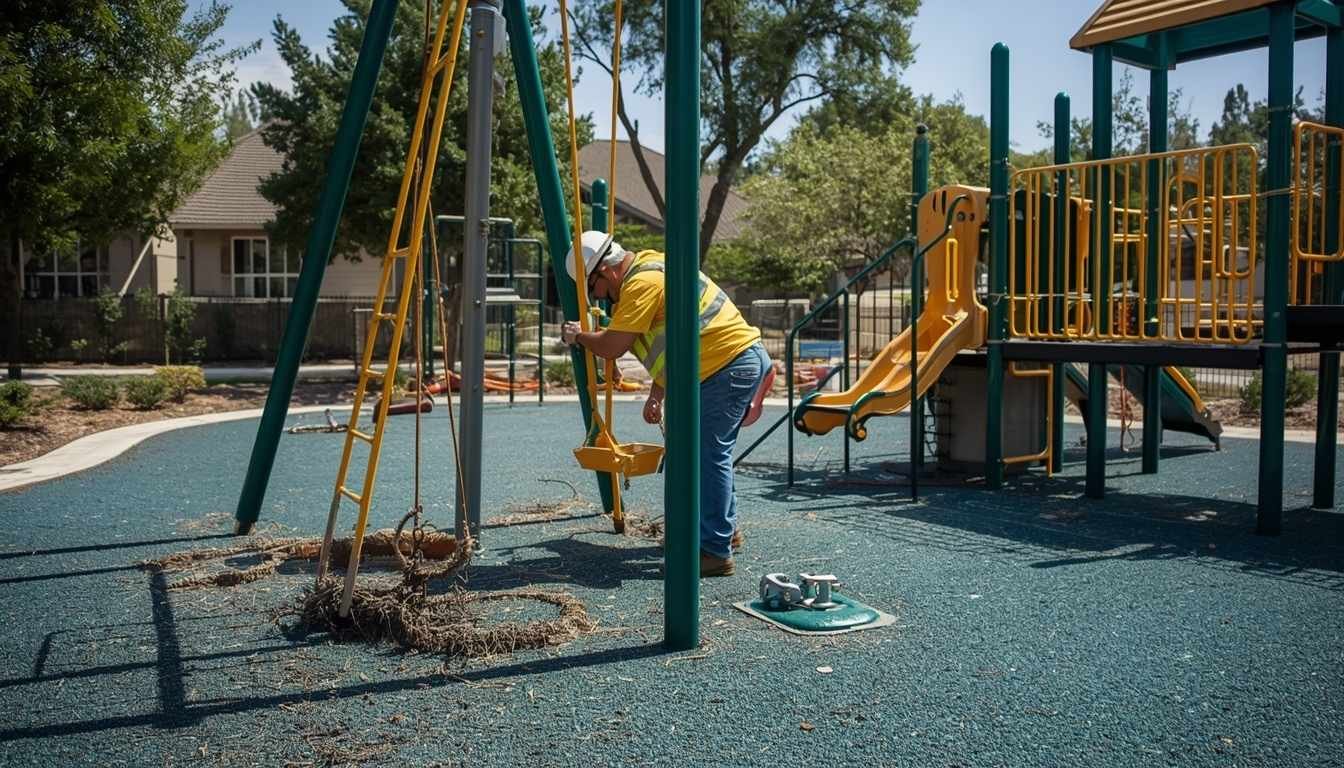
When playground equipment becomes unsafe or suffers unexpected damage, California schools, parks and community organizations may need to arrange repairs or replacements quickly. Broken swings, unstable climbing structures, damaged platforms and deteriorating safety surfaces can create risks that make continued playground use inappropriate.
Emergency spending for playground equipment California communities undertake requires more than finding replacement equipment and approving a purchase. Organizations must identify the hazard, determine the appropriate repair, establish available funding and follow applicable purchasing and safety requirements.
The right approach depends on who operates the playground, how serious the damage is and whether the project qualifies for emergency assistance or an existing capital improvement program.
Key Takeaways
- Emergency playground spending should address documented safety hazards rather than routine upgrades.
- California parks and schools may have different funding and purchasing options.
- State park grants can support playground renovation and new recreational facilities.
- Public playground equipment and replacement components must meet applicable safety standards.
- Inspection reports, repair estimates and procurement records help justify urgent spending decisions.
What Qualifies as an Emergency Playground Equipment Expense?
An emergency expense usually involves an unexpected condition that creates an immediate safety concern or makes part of a playground unusable.
Examples include:
- Broken structural supports: Cracked posts, unstable platforms or damaged climbing frames that could collapse.
- Severe storm damage: Fallen trees, damaged playground structures or displaced equipment following high winds.
- Unsafe swings and slides: Broken suspension components, sharp edges, loose connections or damaged slide sections.
- Damaged playground surfacing: Missing rubber tiles, exposed concrete or displaced protective materials that increase fall-related risks.
- Fire or vandalism damage: Burned structures, exposed metal or equipment that has become unsafe after intentional damage.
Not every replacement qualifies as an emergency. Equipment that has simply aged or become outdated generally belongs in a planned maintenance or capital improvement budget.
The important distinction is whether delaying the work creates an immediate risk that cannot reasonably wait for the normal purchasing process.
Where California Organizations Can Find Playground Funding
Funding availability depends on the organization and the reason for the expense. Some programs support long-term park improvements rather than immediate emergency purchases.
1. California Statewide Park Development Program
The Statewide Park Development and Community Revitalization Program is an important funding opportunity for communities planning new parks or improvements to existing recreational spaces.
For the fifth funding round in 2026:
- Approximately $188.5 million is available statewide.
- Eligible applicants can request between $200,000 and $8.5 million.
- Applications are due December 17, 2026.
- Funding is directed toward critically underserved and climate-vulnerable communities.
Eligible project activities can include playground improvements as part of broader recreational development. However, applicants should review the current application guidelines rather than assume that an isolated emergency equipment purchase qualifies. California State Parks+2
This program may be appropriate for a city or nonprofit planning a substantial playground renovation rather than an immediate replacement of one broken component.
2. School Facility Hardship Funding
California public school districts facing serious facility-related health and safety threats may investigate the School Facility Program’s Facility Hardship provisions.
The program can support eligible rehabilitation or replacement projects when qualifying conditions create an imminent threat to students or staff.
However, playground equipment does not automatically qualify.
The program focuses on school buildings and related required components. Routine maintenance, replacing equipment simply because it has reached the end of its useful life and adding previously nonexistent components do not independently meet the eligibility criteria. dgs.ca.gov+1
School administrators should contact the Office of Public School Construction before treating playground replacement as an eligible hardship project.
3. City and County Emergency Budgets
Local governments may have existing emergency funds, public works budgets or park maintenance allocations that can support urgent repairs.
For example, a city experiencing unexpected playground damage may use an appropriate local funding source to address an immediate hazard while planning a larger replacement project separately.
California Public Contract Code Section 22050 provides an emergency contracting procedure for qualifying public agencies. It allows certain emergency repairs, replacements and directly related purchases without the usual competitive bidding notice when statutory conditions are satisfied.
Under this provision, the governing body generally must make the required emergency finding by a four-fifths vote and document why competitive bidding would create an unacceptable delay. Delegated authority and continuing emergency reviews are also subject to statutory requirements. Justia Law+1
Organizations should confirm which procurement rules apply to their agency before making an emergency purchase.
4. Community Partnerships and Private Funding
Nonprofit organizations, neighborhood associations and community groups may have additional funding options.
Potential sources include:
- Local community foundations
- Corporate sponsorships
- Private charitable donations
- Neighborhood improvement funds
- Business community partnerships
- School and parent fundraising groups
These options can help cover smaller replacement expenses or contribute matching funds toward a larger playground project.
However, private funding does not remove applicable playground safety, accessibility or installation requirements.
How to Prepare an Emergency Playground Equipment Request
A well-documented request helps decision-makers understand why money is needed and what work should happen first.
Organizations should avoid submitting a request that only states that playground equipment is old or needs improvement.
Instead, document the actual problem and explain its impact.
Step 1. Identify the Immediate Safety Problem
Inspect the affected equipment and record the visible damage.
Include:
- The playground location
- The affected equipment
- The type of damage
- The date the problem was identified
- Whether the area has been closed
- Any immediate risks to children
Photographs can help show the condition of the equipment before repairs begin.
Step 2. Obtain a Qualified Safety Inspection
A visual review by maintenance staff can identify obvious problems, but a qualified playground safety inspection provides a more useful assessment.
California Health and Safety Code Section 115725 requires an initial inspection by a playground safety inspector certified by the National Playground Safety Institute to assist with compliance for applicable public playground construction and modifications.
The inspection should help identify whether the equipment requires repair, replacement or additional safety measures. FindLaw+1
Step 3. Separate Emergency Work From Long-Term Improvements
Not every playground improvement needs to happen immediately.
Divide the proposed work into two categories:
Immediate safety work
- Remove or isolate dangerous equipment.
- Repair or replace damaged structural components.
- Address hazardous surfacing.
- Secure affected areas.
- Restore safe access where possible.
Long-term improvements
- Add new play structures.
- Expand recreational areas.
- Improve landscaping.
- Install additional shade.
- Upgrade the playground for broader age groups.
This distinction helps prevent unnecessary spending during an emergency.
Step 4. Collect Written Estimates
Request detailed estimates that identify:
- Equipment and replacement components
- Removal and disposal expenses
- Installation labor
- Protective surfacing
- Site preparation
- Freight and delivery
- Accessibility improvements
- Inspection and testing costs
When time allows, compare multiple qualified suppliers.
If an emergency procurement exception applies, retain the available price comparisons and explain why the selected supplier was appropriate under the circumstances.
Step 5. Submit the Funding Request
The request should include a short explanation of the hazard, supporting inspection documents, photographs, estimated costs and the proposed repair timeline.
The responsible department should also identify the budget or funding program that can legally cover the work.
California Playground Emergency Spending
| Factor | Important information |
|---|---|
| Main reason for emergency spending | Immediate safety concerns or unexpected damage |
| State playground safety law | Health and Safety Code Section 115725 |
| Emergency procurement | Public Contract Code Section 22050 when applicable |
| State park grant funding | Statewide Park Development Program |
| 2026 state park grant allocation | Approximately $188.5 million |
| Maximum Round 5 request | $8.5 million |
| Round 5 application deadline | December 17, 2026 |
| Playground inspection | Qualified certified playground safety inspector |
| Main supporting documents | Inspection report, photographs and cost estimates |
Funding figures and application deadlines reflect the 2026 Statewide Park Program Round 5 information.
Playground Safety Requirements Before Approving Replacement Equipment
Emergency spending should never result in equipment being installed without considering applicable safety requirements.
California has specific rules for playgrounds open to the public.
ASTM and CPSC Playground Standards
Under California Health and Safety Code Section 115725, new public playgrounds and replacement equipment or modified components in existing playgrounds must conform to applicable playground-related ASTM standards and U.S. Consumer Product Safety Commission guidelines.
Important considerations include:
- Equipment design and structural stability
- Age-appropriate play activities
- Fall zones around equipment
- Protective playground surfacing
- Equipment spacing
- Entrapment and protrusion hazards
- Inspection and maintenance requirements
The CPSC’s Public Playground Safety Handbook provides practical guidance for evaluating playground design, equipment placement and maintenance. FindLaw+1
Accessible Playground Features
Accessibility should be considered when selecting replacement equipment and planning modifications.
Evaluate:
- Accessible routes into the play area
- Stable and usable playground surfaces
- Access to appropriate play activities
- Accessible entry points and transfer features
- Connections between accessible routes and play components
The applicable ADA requirements and California building standards should be reviewed for the specific project.
A replacement structure should not be selected based only on its price or delivery speed.
Protective Surfacing Matters
Playground surfacing is an important part of injury prevention.
Common options include:
- Poured-in-place rubber
- Rubber playground tiles
- Engineered wood fiber
- Other approved impact-attenuating materials
The appropriate material depends on equipment height, expected use, accessibility needs, drainage and maintenance requirements.
ASTM F1292 addresses impact attenuation for playground surfacing. ASTM F1951 addresses accessibility characteristics of playground surfaces. U.S. Consumer Product Safety Commission+1
How to Choose the Right Emergency Playground Equipment Solution
The best purchasing decision depends on the severity of the damage, the remaining condition of the playground and the available budget.
Before approving emergency spending playground equipment California organizations should compare repair and replacement options rather than automatically purchasing a complete new structure.
Repair or Replace: Which Option Makes More Sense?
| Decision factor | Repair | Full replacement |
|---|---|---|
| Damage | Limited to specific components | Major structural damage |
| Existing structure | Stable and suitable for continued use | Unsafe or beyond practical repair |
| Cost | Lower when compatible parts are available | Higher initial investment |
| Installation | Usually less extensive | May require site preparation |
| Long-term value | Suitable for equipment with useful life remaining | Better when repeated repairs are necessary |
When Repair Is the Better Choice
Choose repair when:
- The main structure remains structurally sound.
- Replacement components are available.
- The damaged section can be safely isolated.
- A qualified inspection supports continued use after repairs.
For example, replacing a damaged swing seat may be more practical than purchasing an entirely new swing structure.
When Full Replacement Is Better
Consider replacement when:
- Structural damage affects multiple components.
- The equipment cannot be restored to a safe condition.
- Compatible replacement parts are unavailable.
- Repeated repairs are becoming expensive.
- The existing structure cannot reasonably accommodate required safety improvements.
A low purchase price should not outweigh long-term safety and maintenance concerns.
Five Questions to Ask Before Approving the Purchase
- Has a qualified inspector identified the actual safety problem?
- Can the damaged equipment be repaired without compromising structural integrity?
- Does the proposed replacement meet applicable safety and accessibility requirements?
- Is the supplier providing installation and site preparation?
- Can the organization document the emergency and justify the selected funding source?
These questions help prevent rushed purchases that create additional maintenance expenses or compliance problems.
Frequently Asked Questions
1. What qualifies as emergency spending for playground equipment in California?
Emergency spending generally addresses unexpected damage or immediate safety hazards that require prompt action. Examples include broken structures, storm damage, unstable equipment and dangerous playground surfaces. The organization must document the circumstances and follow applicable funding and procurement requirements.
2. Can California cities purchase playground equipment without competitive bidding during an emergency?
Certain public agencies may use emergency procurement procedures under California Public Contract Code Section 22050. The applicable requirements include documented emergency findings and the required governing body approval or properly delegated authority. Not every urgent purchase automatically qualifies.
3. Are playground repairs eligible for California state grants?
Some California state park grant programs support playground renovation and broader recreational improvements. Eligibility depends on the program’s guidelines, applicant type, project scope and funding priorities. A routine repair or isolated equipment purchase should not be assumed eligible.
4. What documents are needed for an emergency playground funding request?
Common supporting documents include:
- Playground inspection reports
- Photographs of damaged equipment
- Written repair or replacement estimates
- Explanation of the immediate safety concern
- Proposed project scope
- Available budget information
- Procurement approval records
Additional documents may be required by the funding program or local agency.
5. Does replacement playground equipment need to meet California safety standards?
Yes. California Health and Safety Code Section 115725 requires applicable ASTM playground standards and CPSC guidelines to be followed when installing new public playgrounds or replacing equipment and modifying components in existing playgrounds.
6. Can nonprofits apply for playground improvement funding in California?
Eligible nonprofit organizations may participate in certain California park funding programs. Requirements vary by grant. Organizations should check applicant eligibility, site ownership or control requirements and project restrictions before preparing an application.
7. How should organizations decide between emergency repairs and complete playground replacement?
Start with a qualified safety inspection and a written repair estimate. Compare the repair cost with replacement expenses, equipment condition, availability of compatible parts and long-term maintenance needs. Repair is often appropriate for isolated damage, while extensive structural problems may justify replacement.
8. Is emergency spending playground equipment California funding available for private playgrounds?
There is no single statewide emergency funding program available to every private playground owner. Private schools, childcare facilities, homeowners associations and other operators should investigate local grants, insurance coverage, private funding and applicable community programs.
Prioritize Safety Before Committing Playground Funds
Emergency playground spending should solve the immediate safety problem without creating additional financial or maintenance issues.
California organizations should begin with a documented inspection, determine whether repair or replacement is necessary and identify a funding source that matches the project.
For larger community improvements, state park grants may offer a longer-term funding opportunity. For immediate hazards, an appropriate local emergency budget and legally compliant procurement process may be more practical.
The most important decision is to ensure that children have access to a safe play environment while public and private organizations use their available funds responsibly.